Birdr

Quail-plover vs Temminck's Courser

Ortyxelos meiffrenii versus Cursorius temminckii

Play a quiz with Quail-plover and Temminck's Courser
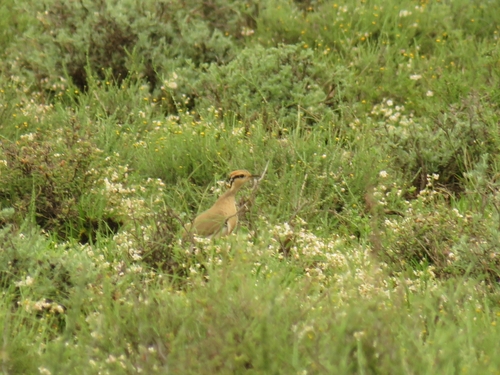
Quail-plover (Ortyxelos meiffrenii) Quail-plover
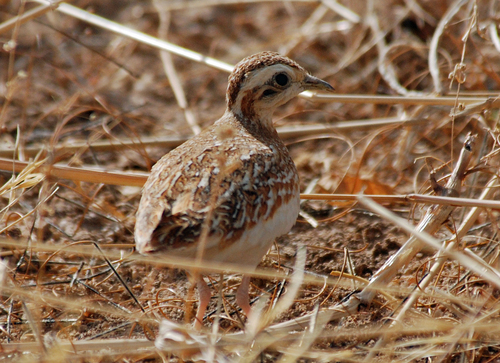
Temminck's Courser (Cursorius temminckii) Temminck's Courser

Media

Loading…

In short

The Quail-plover and Temminck's Courser can be distinguished by their size, plumage, and behavior. The Quail-plover is smaller and more buttonquail-like, while Temminck's Courser is larger with distinctive facial markings. Their habitats overlap in dry regions, but their behaviors and plumage provide reliable identification cues.

Identification tips

  1. Size and Shape: Note the smaller, more compact shape of the Quail-plover compared to the larger, elongated Temminck's Courser. 2. Facial Markings: Look for the bold white supercilium and dark eye stripe on Temminck's Courser. 3. Behavior: Observe behavior; Temminck's Courser is more likely to be seen in open areas and near recent burns. 4. Plumage: Quail-plover has cryptic plumage, while Temminck's Courser has a more defined facial pattern.

Size

The Quail-plover is smaller and more compact compared to the larger, more elongated Temminck's Courser.

Plumage

Quail-plover has a more cryptic, mottled plumage suited for camouflage, while Temminck's Courser is characterized by a striking facial pattern with a bold white supercilium and dark eye stripe.

Behaviour

Quail-plover is more secretive and often remains hidden in grass, while Temminck's Courser is more likely to be seen in open areas, sometimes following fires to feed and nest.

Habitat

Both species inhabit dry, open areas, but Temminck's Courser is more associated with recently burned grasslands and open savannas.

Submit a better description

Use the same sections as the comparison. Your text is published immediately.

The Quail-plover and Temminck's Courser can be distinguished by their size, plumage, and behavior. The Quail-plover is smaller and more buttonquail-like, while Temminck's Courser is larger with distinctive facial markings. Their habitats overlap in dry regions, but their behaviors and plumage provide reliable identification cues.

  1. Size and Shape: Note the smaller, more compact shape of the Quail-plover compared to the larger, elongated Temminck's Courser. 2. Facial Markings: Look for the bold white supercilium and dark eye stripe on Temminck's Courser. 3. Behavior: Observe behavior; Temminck's Courser is more likely to be seen in open areas and near recent burns. 4. Plumage: Quail-plover has cryptic plumage, while Temminck's Courser has a more defined facial pattern.

The Quail-plover is smaller and more compact compared to the larger, more elongated Temminck's Courser.

Quail-plover has a more cryptic, mottled plumage suited for camouflage, while Temminck's Courser is characterized by a striking facial pattern with a bold white supercilium and dark eye stripe.

Quail-plover is more secretive and often remains hidden in grass, while Temminck's Courser is more likely to be seen in open areas, sometimes following fires to feed and nest.

Both species inhabit dry, open areas, but Temminck's Courser is more associated with recently burned grasslands and open savannas.

Discard your changes?

You have unsaved edits. If you leave now, those changes will be lost.

Quail-plover · Temminck's Courser · My Tricky Birds