
Red-and-white Crake vs Rufous-faced Crake
Rufirallus leucopyrrhus versus Rufirallus xenopterus
Play a quiz with Red-and-white Crake and Rufous-faced Crake
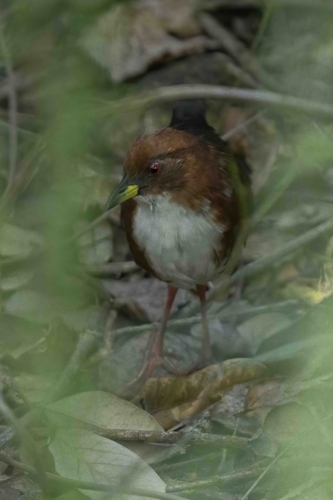 Red-and-white Crake
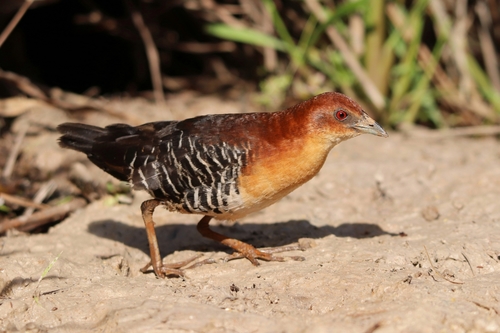 Rufous-faced Crake
In short
The most reliable field mark between Red-and-white Crake and Rufous-faced Crake is the color of the legs and bill: Red-and-white Crake shows bright coral red to salmon-pink legs and a mostly black bill with yellow and greenish tones, while Rufous-faced Crake has blue-gray legs, feet, and bill. Both species share a rufous/chestnut head and white underparts, but differ in the extent and tone of rufous, flank and undertail patterns, and upperwing markings. In flight or at rest, pay close attention to the undertail and the pattern of the upperwing coverts and flanks. Vocalizations are similar but subtly different in pace and tone. Both can occur in Brazil and Paraguay, so range alone is not diagnostic.
Identification tips
- Leg and foot color: Red-and-white Crake has bright coral red to salmon-pink legs; Rufous-faced Crake has blue-gray legs and feet. This is the quickest and most reliable field mark in good light.
- Bill color: Red-and-white Crake's bill is mostly black with a yellow base and light green to blue tip; Rufous-faced Crake's bill is blue-gray throughout. Check the bill base and tip for subtle color differences if legs are obscured.
- Head and neck color: Red-and-white Crake shows a bright chestnut head, neck, and back with a sharp cutoff to the white throat and breast. Rufous-faced Crake has a rufous face, hindneck, and upper back, but the foreneck and breast are buffy ochraceous, not white or chestnut.
- Upperparts and back: Red-and-white Crake's back is bright chestnut merging to dark olive brown upperparts; Rufous-faced Crake's upper back is rufous, but the rest of the upperparts are not described as olive brown.
- Flank pattern: Both species have black and white barring on the flanks, but Rufous-faced Crake also has black and white bars on upperwing coverts, secondaries, and scapulars, which may be visible in flight or when the wing is spread.
- Undertail coverts: Red-and-white Crake has undertail coverts with a black center and white edges, creating a bordered look; Rufous-faced Crake's undertail coverts are entirely black, lacking the white edge.
- Tail color: Rufous-faced Crake's tail is black; Red-and-white Crake's tail color is not specified, but undertail pattern is distinctive.
- Breast and belly: Red-and-white Crake has a white throat and breast; Rufous-faced Crake has a white throat and belly, but the foreneck and breast are buffy ochraceous, not white.
- Voice: Red-and-white Crake's song is a prolonged, throaty chatter or resonant trill, sometimes in duet, with a harsh 'chrrrrrr...' aggressive call. Rufous-faced Crake gives a drawn-out, slightly descending trill and soft 'piú piú' notes. Listen for duets and harsh calls for Red-and-white Crake.
- Geographic range: Red-and-white Crake occurs in Argentina, Brazil, Paraguay, and Uruguay; Rufous-faced Crake is found in Bolivia, Brazil, and Paraguay. In Argentina or Uruguay, only Red-and-white Crake is expected; in Bolivia, only Rufous-faced Crake. In Brazil and Paraguay, both occur, so range is not diagnostic.
- Sex and age: Both species are sexually monomorphic (sexes alike) and no age-specific plumage differences are described, so all field marks apply to adults and immatures alike.
- Size: Both species are essentially identical in size and weight; do not use size for separation.
- Flight views: If flushed, check for the pattern on the upperwing coverts and undertail coverts; Rufous-faced Crake shows black and white barring on the upperwing, while Red-and-white Crake's upperwing is less distinctly marked but undertail coverts are black with white edges.
- Plumage pitfalls: Both species have rufous on the head and black and white barring on the flanks, so beware of relying on these features alone. Focus on leg and bill color, undertail pattern, and breast color for a confident ID.
- Habitat: Both are wetland birds and can occur together in Brazil and Paraguay; do not rely on habitat for separation unless outside the overlap zone.
Size
Both species are very close in size, with Red-and-white Crake measuring 14–17 cm (average about 45 g, range 34–52 g) and Rufous-faced Crake about 14 cm and 52 g. In the field, size is not helpful for separation as there is complete overlap in both length and mass. Sexes are alike in both species.
Plumage
No age-specific upperwing or flight marks are described for either species, so focus is on adult and general plumage. Red-and-white Crake has a bright chestnut head, neck, and back, sharply set off from a white throat and breast; the rest of the upperparts are dark olive brown. Its flanks are barred black and white, and the undertail coverts are distinctive with a black center and white edges. Rufous-faced Crake, by contrast, has a rufous face, hindneck, and upper back, but the foreneck and breast are buffy ochraceous, not white or chestnut. Its upperwing coverts, secondaries, scapulars, and flanks are all barred black and white, but the tail and undertail coverts are entirely black (not edged white). The bill and leg colors are also diagnostic: Red-and-white Crake has a black bill with yellow and greenish tones and bright coral to salmon-pink legs, while Rufous-faced Crake has blue-gray bill, legs, and feet. These contrasts are present in adults; no juvenile-specific differences are described.
Behaviour
Both species are secretive rails, typically skulking in dense wetland vegetation. There are no described differences in behavior, jizz, or flight style between the two. Both may be difficult to observe except when flushed or calling.
Habitat
Both species occur in Brazil and Paraguay, but Red-and-white Crake also ranges into Argentina and Uruguay, while Rufous-faced Crake is found in Bolivia instead. Both are associated with wetland habitats, but the notes do not specify microhabitat differences. Thus, habitat is not a reliable separator where ranges overlap.
Voice
Both species give trilled songs, but Red-and-white Crake's song is described as a prolonged, throaty chatter or resonant trill, sometimes in duet, while Rufous-faced Crake's is a drawn-out, slightly descending trill. Red-and-white Crake also gives a low 'cui' whistle as an alarm and a harsh 'chrrrrrr...' as an aggressive call; Rufous-faced Crake gives soft 'piú piú' notes. These differences are subtle and may be hard to distinguish in the field, but the duet and harsh calls are more typical of Red-and-white Crake.