
Red-billed Firefinch vs Lark-like Bunting
Lagonosticta senegala versus Emberiza impetuani
Play a quiz with Red-billed Firefinch and Lark-like Bunting
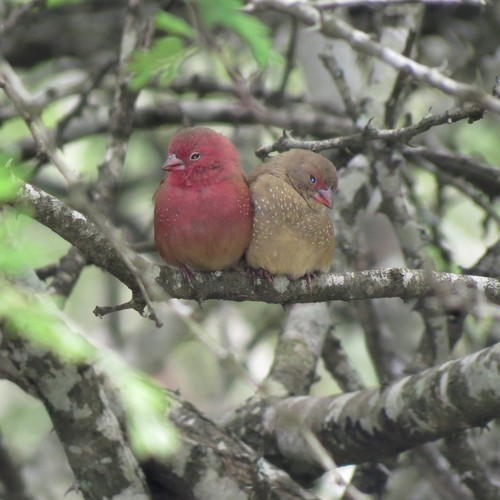 Red-billed Firefinch
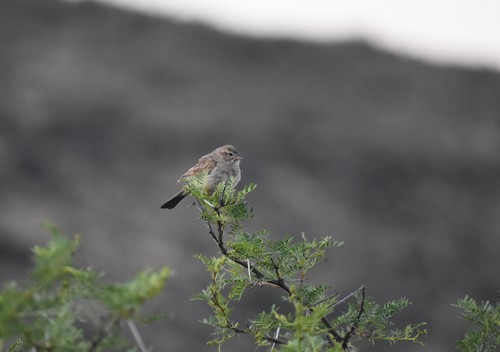 Lark-like Bunting
In short
The most reliable field mark between Red-billed Firefinch and Lark-like Bunting is overall color: male firefinches are vivid scarlet with brown wings, while lark-like buntings are never red and appear much drabber. Females and immatures can be trickier, but firefinch females are small, warm brown birds with a pink bill and a tiny red patch before the eye, while lark-like buntings are larger, plain, streaky-brown birds with a heavier, conical bill. In flight or at rest, the firefinch’s compact size and bright colors (in males) or subtle facial red (in females) are key, while the bunting’s larger, lark-like build and lack of any red stand out. Both species can occur in open country, but their structure, bill shape, and especially any hint of red on the firefinch are the best field clues.
Identification tips
- Male Red-billed Firefinch is bright scarlet except for brown wings—no other confusion species in the region is this red. If you see a small, red bird with brown wings and a pink bill, it is a male firefinch.
- Female firefinch has a small red patch in front of the eye—this is subtle but diagnostic if visible. Lark-like Bunting never shows any red on the face.
- Bill shape and color: Firefinch has a small, delicate, pink bill; bunting has a heavier, conical, horn-colored bill. Bill color is especially useful in good light.
- Size and structure: Firefinch is much smaller and more compact than the bunting, which is bulkier and longer-bodied. Use this when both are seen in the same context or with known species.
- Eye-ring: Male firefinch shows a yellow eye-ring, which is absent in the bunting.
- Underparts: Female firefinch is buff below, while the bunting is more uniformly brown or streaky, without a warm buff tone.
- Upperparts: Female firefinch is uniformly brown above; bunting may show faint streaking or a more patterned back, but is always plainer overall.
- Facial pattern: Only the firefinch has a red facial spot; bunting’s face is plain, sometimes with a faint supercilium but never any red.
- Behavior: Firefinches move quickly and in tight groups, often low to the ground; buntings are more solitary or in loose groups, with a more upright, lark-like stance.
- Habitat: If in lush grassland or near cultivation, firefinch is more likely; in dry, shrubby country, bunting is expected.
- Flight views: No distinctive wing patterns are described for either species, so rely on size, structure, and any flash of red (firefinch) or lack thereof (bunting).
- Perched views: Look for the firefinch’s pink bill and facial red, or the bunting’s heavier bill and plain, streaky plumage.
- Juvenile/immature confusion: Both are brownish when young, but only firefinch juveniles may show a hint of the red facial patch as they age; buntings remain plain.
- Sex differences: Male firefinch is diagnostic; female firefinch vs bunting requires careful attention to bill shape, facial red, and overall size.
- Common pitfall: Drab female firefinches can be mistaken for buntings, especially in poor light—always check for the red facial spot and bill color.
Size
Red-billed Firefinch is noticeably smaller and lighter, averaging 8.5 g, compared to the Lark-like Bunting’s 14.8 g. In the field, firefinches look delicate and compact, while buntings are bulkier, with a more robust, lark-like jizz. This size difference is especially apparent when both species are seen together or near familiar reference birds.
Plumage
Adult male Red-billed Firefinch is unmistakable with its almost entirely scarlet plumage except for brown wings, a pink bill, and a yellow eye-ring. Females are much plainer: warm brown above, buff below, but always with a small red patch in front of the eye and a pink bill. Lark-like Bunting, by contrast, is never red at any age or sex; both sexes are plain brown, often with subtle streaking and a generally washed-out appearance. The bunting lacks any facial red or pink bill. No sources describe distinctive juvenile or immature wing patterns for either species, so separation relies on overall color and facial pattern for all ages.
Behaviour
Red-billed Firefinch is a gregarious, seed-eating bird, often seen in small flocks feeding on the ground or perched low in vegetation. Its movements are quick and somewhat mouse-like. Lark-like Bunting is also a ground forager but tends to be less gregarious, moving with a more deliberate, lark-like gait and often perching on exposed shrubs or fence lines. The bunting’s heavier build and more upright stance can be a subtle behavioral clue.
Habitat
Red-billed Firefinch frequents open grassland, cultivated fields, and areas with scattered bushes, often near human habitation. Lark-like Bunting prefers drier, subtropical or tropical shrubland and is more typical of arid, open country in southwestern Africa. While both can be found in open habitats, firefinch is more likely in wetter, grassy areas, and bunting in drier, shrubbier landscapes.