
Red-breasted Flycatcher vs Common Redstart
Ficedula parva versus Phoenicurus phoenicurus
Play a quiz with Red-breasted Flycatcher and Common Redstart
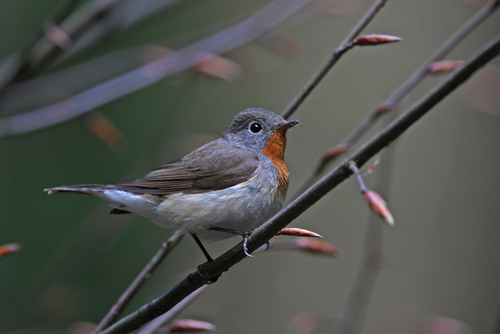 Red-breasted Flycatcher
 Common Redstart
In short
The most reliable way to separate Red-breasted Flycatcher from Common Redstart is by focusing on tail and wing pattern, especially in flight or on perched birds with spread tails. Red-breasted Flycatcher of all ages shows a black tail with conspicuous white bases to the outer feathers, while Common Redstart has a bright orange-red tail with only the central feathers dark. Adult male Common Redstart also shows a white forehead and, in some subspecies, a pale wing patch, which Red-breasted Flycatcher never has. Females and immatures of both species can be confusing, but Redstart is larger, slimmer, and has a more upright, robin-like stance, while Red-breasted Flycatcher is smaller and rounder with a prominent white eyering. Vocalizations, habitat, and feeding behavior can help, but tail and wing pattern are the most consistent clues.
Identification tips
- Tail pattern (all ages): Red-breasted Flycatcher always shows a black tail with white bases to the outer feathers; Common Redstart has a bright orange-red tail with only the central feathers dark. This is the single most reliable field mark, especially when the tail is fanned or in flight.
- Tail color and movement: Common Redstart's orange-red tail is frequently quivered and very obvious; Red-breasted Flycatcher's tail is darker and usually flicked upwards with wingtips down.
- White eyering: Red-breasted Flycatcher of all ages and sexes shows a clear white eyering; Common Redstart lacks this, appearing plainer-faced.
- Bill structure and color: Red-breasted Flycatcher has a black bill with a pale pinkish base, more extensive than in Common Redstart, but this is subtle and best seen up close.
- White forehead (adult male Redstart): Only Common Redstart adult males have a white forehead and black face/throat; Red-breasted Flycatcher never shows this combination.
- Orange throat patch (adult male Red-breasted Flycatcher): Breeding male Red-breasted Flycatcher has a prominent orange throat patch; female and immature Red-breasted Flycatcher lack it, as do all Common Redstarts.
- Wing patch (male Redstart): Adult male Common Redstart (especially the southeastern subspecies) shows a pale to whitish wing patch; Red-breasted Flycatcher never has a wing patch.
- Underpart color: Red-breasted Flycatcher is white below (except for the orange throat in adult males); Common Redstart males are orange on the flanks and belly, fading to white centrally. Females of both are pale below, but Redstart is buffier.
- Size and shape: Common Redstart is larger, slimmer, and longer-tailed; Red-breasted Flycatcher is smaller and rounder. In direct comparison, this can be obvious, but alone it is subtle.
- Perching posture: Common Redstart often perches upright, robin-like; Red-breasted Flycatcher is more horizontal and compact.
- Habitat context: Red-breasted Flycatcher prefers mature forests, often near water; Common Redstart is more likely in open woodland, parks, or gardens.
- Vocalizations: Red-breasted Flycatcher sings a short, sweet, repetitive whistle; Common Redstart's song is longer, softer, and more complex. Calls are also different but require experience.
- Seasonal confusion: In autumn, male Common Redstart can look duller and more female-like, but the orange tail and white forehead (if visible) remain good clues. Red-breasted Flycatcher never shows a white forehead or orange tail.
- Immature/female confusion: Female and immature Redstarts may show a faint pale wing patch, but never a white eyering or black-and-white tail. Red-breasted Flycatcher females/immatures are plainer brown and always have the white eyering and tail pattern.
- Feeding behavior: Both sally for insects, but Redstart is more likely to be seen on the ground or open perches, while Red-breasted Flycatcher stays higher and flicks its tail upwards.
Size
Red-breasted Flycatcher is the smaller of the two, measuring about 11–12 cm in length, only slightly bigger than a Eurasian Wren. Common Redstart is noticeably larger at 13–14.5 cm and also somewhat heavier. In the field, Redstart often looks slimmer and more elongated, while Red-breasted Flycatcher appears compact and short-tailed by comparison. These differences are subtle but can be useful when seen side by side or with experience.
Plumage
- Juvenile/Immature/Non-breeding birds:
- Red-breasted Flycatcher: All ages and sexes show a black tail with white bases to the outer tail feathers, which is diagnostic. The upperparts are muted brown, underparts white, and there is always a clear white eyering. Females and immatures lack the orange throat patch but otherwise resemble adult males.
- Common Redstart: All ages have a bright orange-red tail with only the two central feathers dark brown. Juveniles and females are grey-brown above and pale below, lacking the white eyering of Red-breasted Flycatcher. Some females and immature males may show a faint pale wing patch, especially in the southeastern subspecies, but this is never as bold as in adult males.
- Adult breeding males:
- Red-breasted Flycatcher: Muted brown above, white below, grey head, and a prominent orange throat patch. No wing patch or white forehead. Bill is black with a pale pinkish base.
- Common Redstart: Slate-grey head and upperparts, white forehead, black face and throat, orange-chestnut rump, tail, and flanks, with a pale to whitish wing patch in some subspecies. Underparts fade to white on the belly. Bill and legs black. In autumn, males look duller due to pale feather fringes.
Behaviour
Both species feed by sallying after insects, but Common Redstart often perches more upright, reminiscent of a robin, and frequently quivers its orange-red tail. Red-breasted Flycatcher is more likely to flick its tail upwards while holding its wingtips down, and inspects leaves and branches in a warbler-like manner. Redstart is more likely to be seen on open perches or even on the ground, while Red-breasted Flycatcher tends to stay in the canopy or mid-levels.
Habitat
Red-breasted Flycatcher breeds in eastern Europe and Central Asia, favoring mature deciduous or mixed forests, especially near water. It is a regular passage migrant in western Europe. Common Redstart breeds widely across Europe and into Siberia, using open woodlands, parks, and gardens, often with scattered trees and more open ground. Both are migratory, but Red-breasted Flycatcher winters in South Asia, while Common Redstart winters in Africa.
Voice
Red-breasted Flycatcher's song is a short, sweet, and repetitive whistle, often preceded by quiet 'zit' notes and followed by a descending sequence, less melodious than European Pied Flycatcher. Its call is a rattling 'zrrrt', slower than Taiga Flycatcher. Common Redstart's song is a soft, melancholy strophe lasting 1–2 seconds, with a three-part structure. Calls vary by region but are generally rising 'huid' or monosyllabic 'heed', sometimes combined with ticking alarms. In the field, Common Redstart's song is more complex and variable, while Red-breasted Flycatcher is simpler and shorter.