Birdr

Red-breasted Sapsucker vs Black-backed Woodpecker

Sphyrapicus ruber versus Picoides arcticus

Play a quiz with Red-breasted Sapsucker and Black-backed Woodpecker
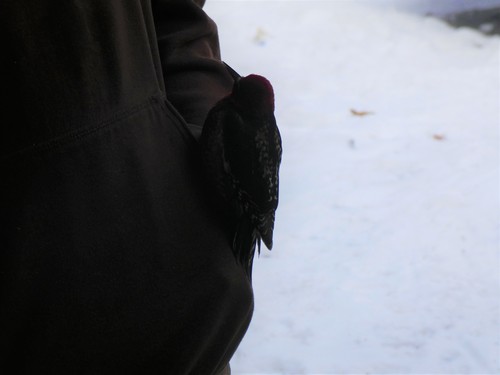
Red-breasted Sapsucker (Sphyrapicus ruber) Red-breasted Sapsucker
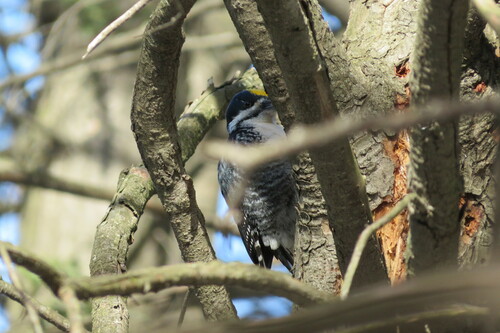
Black-backed Woodpecker (Picoides arcticus) Black-backed Woodpecker

Media

Loading…

In short

The Red-breasted Sapsucker (Sphyrapicus ruber) and the Black-backed Woodpecker (Picoides arcticus) are both woodpeckers but differ significantly in appearance and habitat preferences. The Red-breasted Sapsucker is notable for its vibrant red head and breast, while the Black-backed Woodpecker is characterized by its sooty black back and yellow crown patch in males.

Identification tips

Size

Both species are similar in size, but the Black-backed Woodpecker may appear slightly bulkier due to its robust build.

Plumage

The Red-breasted Sapsucker has a striking red head and breast with a black and white mottled back. In contrast, the Black-backed Woodpecker has a predominantly black back with a white underbelly, and males have a yellow crown patch instead of red.

Behaviour

The Black-backed Woodpecker is often found foraging on burned trees and can be quite approachable, sometimes challenging intruders with its distinctive calls. The Red-breasted Sapsucker is known for drilling sap wells and may be seen more frequently on live trees.

Habitat

Red-breasted Sapsuckers are typically found in mixed woodlands and forests, while Black-backed Woodpeckers prefer recently burned forests where they can blend in with charred bark.

Voice

The Black-backed Woodpecker has a unique and complex 'Scream-Rattle-Snarl' call, which is distinctive among woodpeckers. The Red-breasted Sapsucker's calls are less distinctive and not as well-documented.

Submit a better description

Use the same sections as the comparison. Your text is published immediately.

The Red-breasted Sapsucker (Sphyrapicus ruber) and the Black-backed Woodpecker (Picoides arcticus) are both woodpeckers but differ significantly in appearance and habitat preferences. The Red-breasted Sapsucker is notable for its vibrant red head and breast, while the Black-backed Woodpecker is characterized by its sooty black back and yellow crown patch in males.

  • Look for the red head and breast of the Red-breasted Sapsucker.
  • Note the black back and yellow crown patch in male Black-backed Woodpeckers.
  • Observe the habitat: Red-breasted Sapsuckers are in mixed forests, while Black-backed Woodpeckers prefer burned areas.
  • Listen for the Black-backed Woodpecker's distinctive calls.

Both species are similar in size, but the Black-backed Woodpecker may appear slightly bulkier due to its robust build.

The Red-breasted Sapsucker has a striking red head and breast with a black and white mottled back. In contrast, the Black-backed Woodpecker has a predominantly black back with a white underbelly, and males have a yellow crown patch instead of red.

The Black-backed Woodpecker is often found foraging on burned trees and can be quite approachable, sometimes challenging intruders with its distinctive calls. The Red-breasted Sapsucker is known for drilling sap wells and may be seen more frequently on live trees.

Red-breasted Sapsuckers are typically found in mixed woodlands and forests, while Black-backed Woodpeckers prefer recently burned forests where they can blend in with charred bark.

The Black-backed Woodpecker has a unique and complex 'Scream-Rattle-Snarl' call, which is distinctive among woodpeckers. The Red-breasted Sapsucker's calls are less distinctive and not as well-documented.

Discard your changes?

You have unsaved edits. If you leave now, those changes will be lost.

Red-breasted Sapsucker · Black-backed Woodpecker · My Tricky Birds