Birdr

Red-cockaded Woodpecker vs Hairy Woodpecker

Leuconotopicus borealis versus Leuconotopicus villosus

Play a quiz with Red-cockaded Woodpecker and Hairy Woodpecker
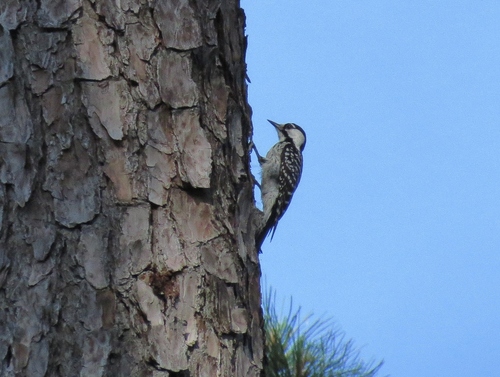
Red-cockaded Woodpecker (Leuconotopicus borealis) Red-cockaded Woodpecker
Hairy Woodpecker (Leuconotopicus villosus) Hairy Woodpecker

Media

Loading…

In short

The Red-cockaded Woodpecker and Hairy Woodpecker can be distinguished by habitat and plumage details. Red-cockaded Woodpeckers are associated with mature pine forests, while Hairy Woodpeckers are more widespread across various forest types. Look for the Red-cockaded's distinctive white cheek patch and lack of a red nape patch in males.

Identification tips

  1. Habitat: Look for Red-cockaded Woodpeckers in mature pine forests; Hairy Woodpeckers are more generalists. 2. Cheek Patch: Red-cockaded Woodpeckers have a distinctive white cheek patch. 3. Nape Patch: Male Hairy Woodpeckers have a red nape patch, absent in Red-cockaded Woodpeckers. 4. Back Pattern: Hairy Woodpeckers have a white back stripe, while Red-cockaded Woodpeckers have more black on their backs.

Size

Both species are similar in size, but the Hairy Woodpecker may appear slightly larger and more robust.

Plumage

The Red-cockaded Woodpecker has a unique white cheek patch and lacks the red nape patch found in male Hairy Woodpeckers. Hairy Woodpeckers have a more uniform black and white pattern with a white back stripe.

Behaviour

Both species exhibit typical woodpecker behavior, such as drumming on trees, but Red-cockaded Woodpeckers are more specialized in their foraging within pine forests.

Habitat

Red-cockaded Woodpeckers are restricted to mature pine forests in the southeastern United States, while Hairy Woodpeckers inhabit a wide range of forested areas across North America.

Voice

Vocalizations are not the most reliable distinguishing feature, but Hairy Woodpeckers have a sharp 'peek' call, while Red-cockaded Woodpeckers have a softer, more nasal call.

Submit a better description

Use the same sections as the comparison. Your text is published immediately.

The Red-cockaded Woodpecker and Hairy Woodpecker can be distinguished by habitat and plumage details. Red-cockaded Woodpeckers are associated with mature pine forests, while Hairy Woodpeckers are more widespread across various forest types. Look for the Red-cockaded's distinctive white cheek patch and lack of a red nape patch in males.

  1. Habitat: Look for Red-cockaded Woodpeckers in mature pine forests; Hairy Woodpeckers are more generalists. 2. Cheek Patch: Red-cockaded Woodpeckers have a distinctive white cheek patch. 3. Nape Patch: Male Hairy Woodpeckers have a red nape patch, absent in Red-cockaded Woodpeckers. 4. Back Pattern: Hairy Woodpeckers have a white back stripe, while Red-cockaded Woodpeckers have more black on their backs.

Both species are similar in size, but the Hairy Woodpecker may appear slightly larger and more robust.

The Red-cockaded Woodpecker has a unique white cheek patch and lacks the red nape patch found in male Hairy Woodpeckers. Hairy Woodpeckers have a more uniform black and white pattern with a white back stripe.

Both species exhibit typical woodpecker behavior, such as drumming on trees, but Red-cockaded Woodpeckers are more specialized in their foraging within pine forests.

Red-cockaded Woodpeckers are restricted to mature pine forests in the southeastern United States, while Hairy Woodpeckers inhabit a wide range of forested areas across North America.

Vocalizations are not the most reliable distinguishing feature, but Hairy Woodpeckers have a sharp 'peek' call, while Red-cockaded Woodpeckers have a softer, more nasal call.

Discard your changes?

You have unsaved edits. If you leave now, those changes will be lost.

Red-cockaded Woodpecker · Hairy Woodpecker · My Tricky Birds