Birdr

Red Collared Dove vs Key West Quail-Dove

Streptopelia tranquebarica versus Geotrygon chrysia

Play a quiz with Red Collared Dove and Key West Quail-Dove
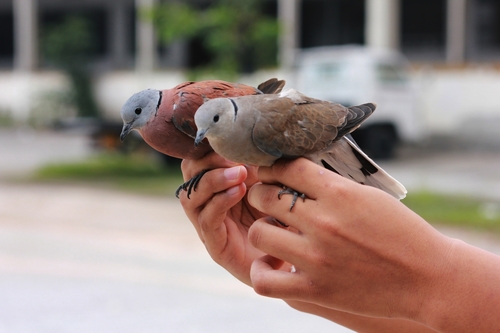
Red Collared Dove (Streptopelia tranquebarica) Red Collared Dove
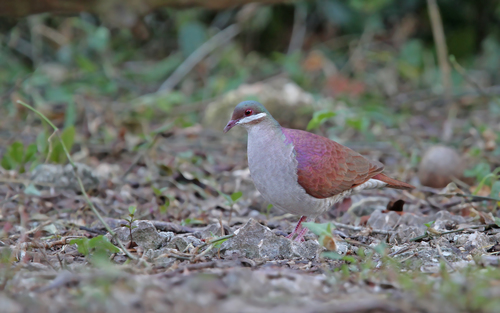
Key West Quail-Dove (Geotrygon chrysia) Key West Quail-Dove

Media

Loading…

In short

The Red Collared Dove and the Key West Quail-Dove are both members of the Columbidae family but differ significantly in appearance and habitat. The Red Collared Dove is more likely to be found in open areas, while the Key West Quail-Dove prefers wooded habitats. Key field marks include the Red Collared Dove's distinctive red collar and the Key West Quail-Dove's iridescent neck and facial pattern.

Identification tips

Size

Both species are medium-sized doves, but the Key West Quail-Dove is generally more robust and slightly larger.

Plumage

The Red Collared Dove has a reddish body with a distinctive black collar around its neck. In contrast, the Key West Quail-Dove features a more muted brown plumage with a striking iridescent patch on the neck and a unique facial pattern with a white line above the eye.

Behaviour

The Red Collared Dove is often seen in open areas and may be more conspicuous, while the Key West Quail-Dove tends to be secretive, foraging on the ground in dense forest undergrowth.

Habitat

Red Collared Doves are typically found in open areas, including farmland and urban environments. Key West Quail-Doves prefer wooded habitats, such as semi-arid and humid woodlands, scrub, and forests.

Voice

Vocalizations are not a primary distinguishing feature between these two species, but the Red Collared Dove's call is a soft cooing sound, while the Key West Quail-Dove's call is less documented and may be less frequently heard.

Submit a better description

Use the same sections as the comparison. Your text is published immediately.

The Red Collared Dove and the Key West Quail-Dove are both members of the Columbidae family but differ significantly in appearance and habitat. The Red Collared Dove is more likely to be found in open areas, while the Key West Quail-Dove prefers wooded habitats. Key field marks include the Red Collared Dove's distinctive red collar and the Key West Quail-Dove's iridescent neck and facial pattern.

  • Red Collared Dove: Look for the black collar and reddish body, often in open areas.
  • Key West Quail-Dove: Note the iridescent neck patch and distinct facial pattern, usually in wooded habitats.
  • Consider habitat and behavior: Red Collared Doves are more likely in open areas, while Key West Quail-Doves prefer dense forest floors.

Both species are medium-sized doves, but the Key West Quail-Dove is generally more robust and slightly larger.

The Red Collared Dove has a reddish body with a distinctive black collar around its neck. In contrast, the Key West Quail-Dove features a more muted brown plumage with a striking iridescent patch on the neck and a unique facial pattern with a white line above the eye.

The Red Collared Dove is often seen in open areas and may be more conspicuous, while the Key West Quail-Dove tends to be secretive, foraging on the ground in dense forest undergrowth.

Red Collared Doves are typically found in open areas, including farmland and urban environments. Key West Quail-Doves prefer wooded habitats, such as semi-arid and humid woodlands, scrub, and forests.

Vocalizations are not a primary distinguishing feature between these two species, but the Red Collared Dove's call is a soft cooing sound, while the Key West Quail-Dove's call is less documented and may be less frequently heard.

Discard your changes?

You have unsaved edits. If you leave now, those changes will be lost.

Red Collared Dove · Key West Quail-Dove · My Tricky Birds