Birdr

Red-faced Cormorant vs Pelagic Cormorant

Urile urile versus Urile pelagicus

Play a quiz with Red-faced Cormorant and Pelagic Cormorant
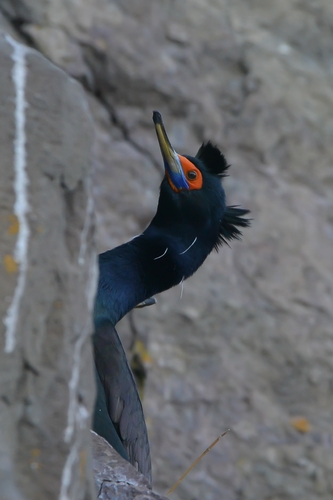
Red-faced Cormorant (Urile urile) Red-faced Cormorant
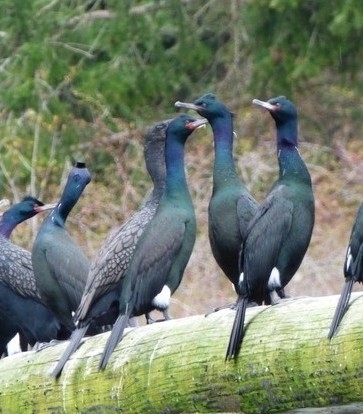
Pelagic Cormorant (Urile pelagicus) Pelagic Cormorant

Media

Loading…

In short

The Red-faced Cormorant and Pelagic Cormorant are similar in appearance, often leading to confusion where their ranges overlap. The most reliable field mark is the red facial skin of the Red-faced Cormorant, which is absent in the Pelagic Cormorant. Both species are marine and share similar behaviors, but differ slightly in habitat preference and plumage details.

Identification tips

Size

Both species are similar in size, with the Red-faced Cormorant being slightly bulkier.

Plumage

The Red-faced Cormorant has a distinctive red facial skin during the breeding season, whereas the Pelagic Cormorant lacks this feature. Both have dark plumage, but the Red-faced Cormorant may appear slightly more iridescent.

Behaviour

Both species exhibit similar behaviors, such as being sensitive to disturbances and drying their plumage on roosts. They are both solitary in nature but may be seen in mixed groups.

Habitat

The Red-faced Cormorant is more associated with remote, steep cliff faces and is less gregarious, while the Pelagic Cormorant is more commonly found in coastal areas and is slightly more social.

Submit a better description

Use the same sections as the comparison. Your text is published immediately.

The Red-faced Cormorant and Pelagic Cormorant are similar in appearance, often leading to confusion where their ranges overlap. The most reliable field mark is the red facial skin of the Red-faced Cormorant, which is absent in the Pelagic Cormorant. Both species are marine and share similar behaviors, but differ slightly in habitat preference and plumage details.

  • Look for red facial skin on the Red-faced Cormorant during the breeding season.
  • Observe habitat: Red-faced Cormorants prefer remote cliffs, while Pelagic Cormorants are more coastal.
  • Note plumage: Red-faced Cormorants may appear more iridescent.

Both species are similar in size, with the Red-faced Cormorant being slightly bulkier.

The Red-faced Cormorant has a distinctive red facial skin during the breeding season, whereas the Pelagic Cormorant lacks this feature. Both have dark plumage, but the Red-faced Cormorant may appear slightly more iridescent.

Both species exhibit similar behaviors, such as being sensitive to disturbances and drying their plumage on roosts. They are both solitary in nature but may be seen in mixed groups.

The Red-faced Cormorant is more associated with remote, steep cliff faces and is less gregarious, while the Pelagic Cormorant is more commonly found in coastal areas and is slightly more social.

Discard your changes?

You have unsaved edits. If you leave now, those changes will be lost.

Red-faced Cormorant · Pelagic Cormorant · My Tricky Birds