Red-footed Falcon vs Eleonora's Falcon
Falco vespertinus versus Falco eleonorae
Play a quiz with Red-footed Falcon and Eleonora's Falcon
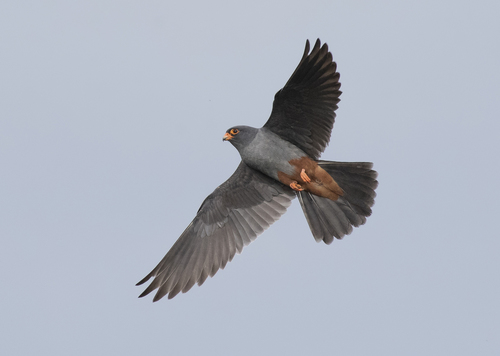
Red-footed Falcon
Eleonora's Falcon
In short
Red-footed Falcon and Eleonora's Falcon are both medium-sized falcons, but they can be distinguished by their plumage and seasonal behaviors. The Red-footed Falcon is more often seen inland, while Eleonora's Falcon is typically coastal during its breeding season. Pay attention to their flight patterns and plumage details for accurate identification.
Identification tips
- Plumage: Look for the red legs and cere in Red-footed Falcons, especially in males. Eleonora's Falcon's polymorphic nature can be confusing; focus on the overall dark or contrasting pale morph.
- Habitat: Consider the location; Eleonora's Falcons are more likely near coasts, while Red-footed Falcons are inland.
- Behavior: Observe hunting behavior; Red-footed Falcons often hunt in groups, whereas Eleonora's Falcons are solitary and agile in flight.
Size
Both species are similar in size, with slender bodies and long wings, typical of falcons.
Plumage
Adult male Red-footed Falcons are slate-gray with red legs and a red cere, while females have a more rufous head and underparts. Eleonora's Falcon is polymorphic, with a dark morph that is uniformly sooty and a pale morph that has a contrasting pale underside. Juveniles of both species can be confusing but look for the Red-footed Falcon's more uniform plumage compared to the contrasting patterns of Eleonora's Falcon.
Behaviour
Red-footed Falcons are often seen hunting in groups, especially during migration, while Eleonora's Falcons are known for their agile and acrobatic flight, often hunting insects on the wing.
Habitat
Red-footed Falcons prefer open habitats such as grasslands and agricultural areas, often away from coasts. Eleonora's Falcons are strongly associated with coastal cliffs and islands, particularly during the breeding season.
Voice
Both species have similar vocalizations, consisting of high-pitched calls, but these are not typically used for identification in the field.