
Red-headed Bunting vs Pine Bunting
Emberiza bruniceps versus Emberiza leucocephalos
Play a quiz with Red-headed Bunting and Pine Bunting
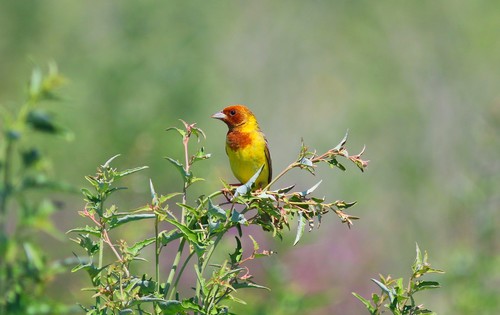
Red-headed Bunting
Pine Bunting
In short
To distinguish between the Red-headed Bunting and the Pine Bunting, focus on head coloration and breast markings. The Red-headed Bunting typically has a more vibrant red head, while the Pine Bunting's head is more subdued with a mix of gray and brown tones.
Identification tips
- Look for the red head in Red-headed Buntings, especially in males. 2. Check for the paler, streaked head and breast in Pine Buntings. 3. Consider the habitat: open fields for Red-headed, wooded areas for Pine. 4. Be cautious with females and immatures, as they can appear similar.
Size
Both species are similar in size, typical of Old World buntings, with no significant differences in structure.
Plumage
The Red-headed Bunting has a striking red head and yellow underparts, while the Pine Bunting exhibits a paler head with gray and brown tones and a more streaked breast. Female and immature birds of both species can be more challenging, with less distinct coloration.
Behaviour
Both species exhibit similar foraging behaviors typical of buntings, often seen feeding on the ground or in low vegetation.
Habitat
Red-headed Buntings are often found in open fields and agricultural areas, whereas Pine Buntings prefer more wooded environments, though there is some overlap in habitat preferences.
Voice
Vocalizations are not the most reliable distinguishing feature, as both species have similar calls typical of buntings. However, the Pine Bunting's song may have a slightly different rhythm.