Birdr

Red-headed Trogon vs Blue-capped Motmot

Harpactes erythrocephalus versus Momotus coeruliceps

Play a quiz with Red-headed Trogon and Blue-capped Motmot
Red-headed Trogon (Harpactes erythrocephalus) Red-headed Trogon
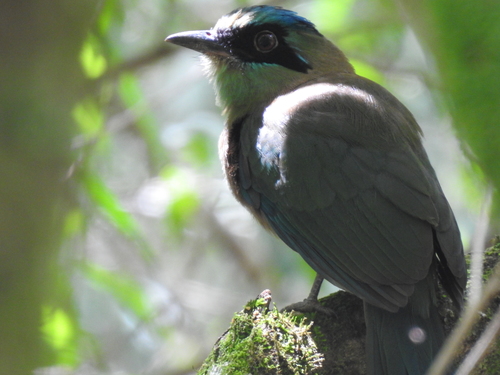
Blue-capped Motmot (Momotus coeruliceps) Blue-capped Motmot

Media

Loading…

In short

The Red-headed Trogon and Blue-capped Motmot are visually distinct, with the trogon having a striking red head and the motmot a notable blue cap. Both species inhabit forested areas but differ in behavior and vocalizations, aiding identification.

Identification tips

1. Head Color: Look for the red head of the trogon versus the blue cap of the motmot. 2. Tail Shape: The motmot's tail is longer and racquet-tipped. 3. Behavior: Note the more active foraging behavior of the motmot. 4. Call: Listen for the motmot's 'hoot' compared to the trogon's softer call.

Size

The Red-headed Trogon is generally more compact and robust, while the Blue-capped Motmot is slightly larger with a longer tail.

Plumage

The Red-headed Trogon has a bright red head and breast, with a contrasting green back and barred underparts. In contrast, the Blue-capped Motmot features a distinctive blue cap, green body, and a racquet-tipped tail.

Behaviour

Red-headed Trogons are often seen perched quietly in the mid-story of forests, while Blue-capped Motmots are more active, often seen foraging on the ground or making short flights.

Habitat

Both species prefer forested habitats, but the Red-headed Trogon is more often found in dense, humid forests, whereas the Blue-capped Motmot can also be found in more open woodlands and edges.

Voice

The Red-headed Trogon has a soft, repetitive call, while the Blue-capped Motmot's call is a distinctive, low 'hoot' or 'whoop'.

Submit a better description

Use the same sections as the comparison. Your text is published immediately.

The Red-headed Trogon and Blue-capped Motmot are visually distinct, with the trogon having a striking red head and the motmot a notable blue cap. Both species inhabit forested areas but differ in behavior and vocalizations, aiding identification.

1. Head Color: Look for the red head of the trogon versus the blue cap of the motmot. 2. Tail Shape: The motmot's tail is longer and racquet-tipped. 3. Behavior: Note the more active foraging behavior of the motmot. 4. Call: Listen for the motmot's 'hoot' compared to the trogon's softer call.

The Red-headed Trogon is generally more compact and robust, while the Blue-capped Motmot is slightly larger with a longer tail.

The Red-headed Trogon has a bright red head and breast, with a contrasting green back and barred underparts. In contrast, the Blue-capped Motmot features a distinctive blue cap, green body, and a racquet-tipped tail.

Red-headed Trogons are often seen perched quietly in the mid-story of forests, while Blue-capped Motmots are more active, often seen foraging on the ground or making short flights.

Both species prefer forested habitats, but the Red-headed Trogon is more often found in dense, humid forests, whereas the Blue-capped Motmot can also be found in more open woodlands and edges.

The Red-headed Trogon has a soft, repetitive call, while the Blue-capped Motmot's call is a distinctive, low 'hoot' or 'whoop'.

Discard your changes?

You have unsaved edits. If you leave now, those changes will be lost.

Red-headed Trogon · Blue-capped Motmot · My Tricky Birds