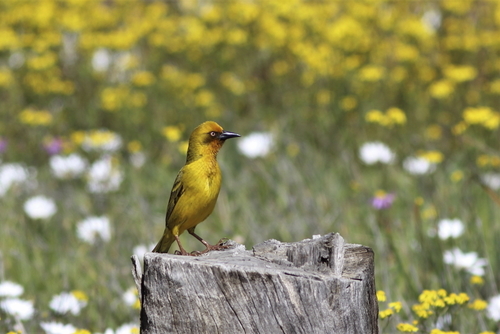
Red-headed Weaver vs Cape Weaver
Anaplectes rubriceps versus Ploceus capensis
Play a quiz with Red-headed Weaver and Cape Weaver
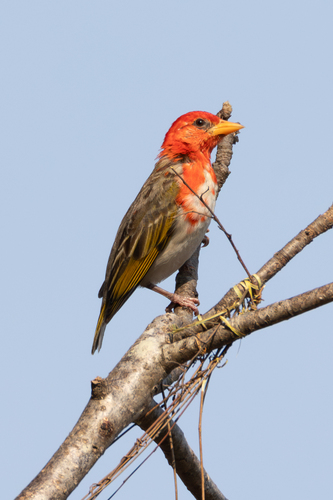
Red-headed Weaver
Cape Weaver
In short
The Red-headed Weaver and Cape Weaver can be distinguished primarily by their head coloration and habitat preferences. The Red-headed Weaver has a striking red head in males, while the Cape Weaver male is bright yellow with orange-brown on the face. Both species are found in different regions of Africa, with the Red-headed Weaver favoring broadleaf woodlands and the Cape Weaver preferring open country with some trees and permanent water.
Identification tips
- Head Color: Look for the red head in male Red-headed Weavers versus the yellow and orange-brown face of male Cape Weavers.
- Bill Length: Cape Weavers have a relatively long bill, useful for ground foraging.
- Habitat: Note the habitat; Red-headed Weavers prefer wooded areas, while Cape Weavers are found in open areas with water.
- Female Plumage: Female Cape Weavers are olive with a yellow throat, which is distinct from female Red-headed Weavers.
Size
Both species are similar in size, typical of weavers, but the Cape Weaver is noted for its relatively long bill.
Plumage
Male Red-headed Weavers have a distinctive red head, while Cape Weaver males are bright yellow with orange-brown on the face. Female Cape Weavers are olive with a yellow throat and belly, contrasting with the less distinctive female Red-headed Weavers.
Behaviour
Red-headed Weavers often join mixed-species foraging flocks, whereas Cape Weavers are found in flocks and form large roosts. Cape Weavers are known to forage mainly on the ground, turning over stones and leaf litter.
Habitat
Red-headed Weavers inhabit broadleaf woodland, bushveld, and well-wooded savanna, while Cape Weavers are found in open country with trees and permanent water, avoiding forests.