Birdr

Red Knot vs Broad-billed Sandpiper

Calidris canutus versus Calidris falcinellus

Play a quiz with Red Knot and Broad-billed Sandpiper
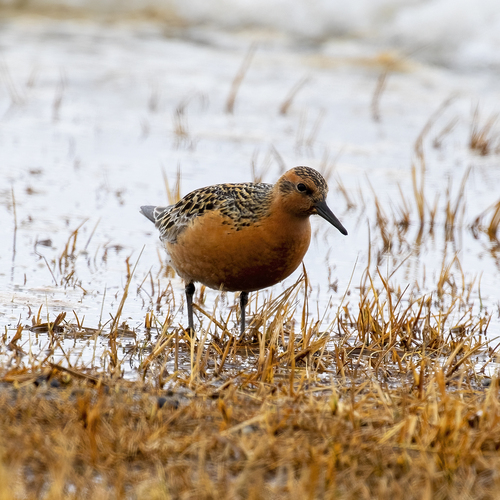
Red Knot (Calidris canutus) Red Knot
Broad-billed Sandpiper (Calidris falcinellus) Broad-billed Sandpiper

Media

Loading…

In short

The Red Knot and Broad-billed Sandpiper can be distinguished by their bill shape and plumage. The Red Knot has a straight, medium-length bill and changes from bright rufous in breeding plumage to dull gray in winter. The Broad-billed Sandpiper has a distinctive slightly decurved bill and a more intricate plumage pattern with a prominent supercilium.

Identification tips

1. Bill Shape: Red Knot has a straight bill; Broad-billed Sandpiper has a slightly decurved bill. 2. Size and Structure: Red Knot is larger and more robust. 3. Plumage: Look for the rufous breeding plumage in Red Knots and the prominent supercilium in Broad-billed Sandpipers. 4. Habitat: Consider the habitat; Red Knots are more marine, while Broad-billed Sandpipers prefer wetlands.

Size

The Red Knot is larger and more robust than the Broad-billed Sandpiper.

Plumage

Red Knots in breeding plumage are rufous with a plain back, while in winter, they are dull gray with few markings. Broad-billed Sandpipers have a more intricate pattern with a prominent white supercilium and streaked back, regardless of the season.

Behaviour

Both species forage in flocks, but Red Knots are known for their long-distance migrations and are often seen in large groups during migration.

Habitat

Red Knots are typically found in marine environments during the non-breeding season, while Broad-billed Sandpipers prefer freshwater or brackish wetlands.

Voice

Vocalizations are not a primary distinguishing feature between these two species in the field.

Submit a better description

Use the same sections as the comparison. Your text is published immediately.

The Red Knot and Broad-billed Sandpiper can be distinguished by their bill shape and plumage. The Red Knot has a straight, medium-length bill and changes from bright rufous in breeding plumage to dull gray in winter. The Broad-billed Sandpiper has a distinctive slightly decurved bill and a more intricate plumage pattern with a prominent supercilium.

1. Bill Shape: Red Knot has a straight bill; Broad-billed Sandpiper has a slightly decurved bill. 2. Size and Structure: Red Knot is larger and more robust. 3. Plumage: Look for the rufous breeding plumage in Red Knots and the prominent supercilium in Broad-billed Sandpipers. 4. Habitat: Consider the habitat; Red Knots are more marine, while Broad-billed Sandpipers prefer wetlands.

The Red Knot is larger and more robust than the Broad-billed Sandpiper.

Red Knots in breeding plumage are rufous with a plain back, while in winter, they are dull gray with few markings. Broad-billed Sandpipers have a more intricate pattern with a prominent white supercilium and streaked back, regardless of the season.

Both species forage in flocks, but Red Knots are known for their long-distance migrations and are often seen in large groups during migration.

Red Knots are typically found in marine environments during the non-breeding season, while Broad-billed Sandpipers prefer freshwater or brackish wetlands.

Vocalizations are not a primary distinguishing feature between these two species in the field.

Discard your changes?

You have unsaved edits. If you leave now, those changes will be lost.

Red Knot · Broad-billed Sandpiper · My Tricky Birds