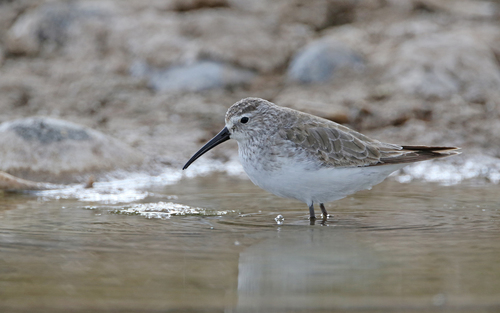
Red Knot vs Curlew Sandpiper
Calidris canutus versus Calidris ferruginea
Play a quiz with Red Knot and Curlew Sandpiper
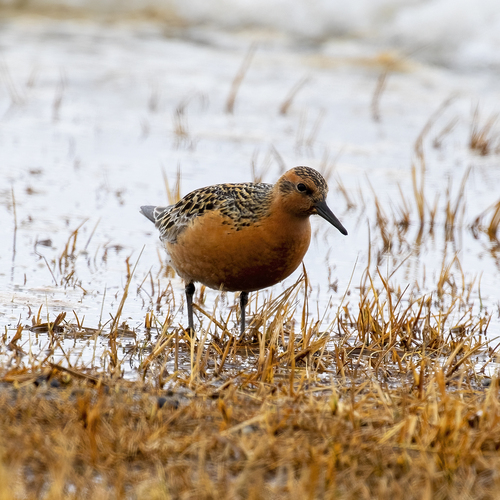
Red Knot
Curlew Sandpiper
In short
The Red Knot and Curlew Sandpiper are both medium-sized shorebirds, but they can be distinguished by their bill shape and plumage. The Curlew Sandpiper has a longer, more decurved bill compared to the shorter, straight bill of the Red Knot. In breeding plumage, the Curlew Sandpiper shows a more extensive reddish wash on its underparts than the Red Knot.
Identification tips
- Bill shape: Look for the longer, decurved bill of the Curlew Sandpiper versus the shorter, straight bill of the Red Knot. 2. Breeding plumage: Note the more extensive reddish underparts of the Curlew Sandpiper. 3. Non-breeding plumage: Check for a more distinct supercilium in the Curlew Sandpiper. 4. Habitat: Consider the habitat; Red Knots are more marine-oriented.
Size
Both species are similar in size, but the Red Knot is slightly bulkier.
Plumage
In breeding plumage, the Red Knot has a brick-red chest and face, while the Curlew Sandpiper has a more uniform reddish wash extending across its underparts. In non-breeding plumage, both species appear gray, but the Curlew Sandpiper often shows a more distinct supercilium.
Behaviour
Both species are migratory shorebirds, but the Red Knot is known for its exceptionally long migrations. They both forage by probing in mud or sand, but the Red Knot often feeds in larger flocks.
Habitat
Both species use coastal habitats during migration and wintering. The Red Knot is more strictly associated with marine shorelines, while the Curlew Sandpiper can also be found in freshwater wetlands.
Voice
Vocalizations are not typically used for field identification of these species, and they are generally quiet outside the breeding season.