Birdr

Red-legged Partridge vs Rock Partridge

Alectoris rufa versus Alectoris graeca

Play a quiz with Red-legged Partridge and Rock Partridge

Red-legged Partridge (Alectoris rufa) Red-legged Partridge
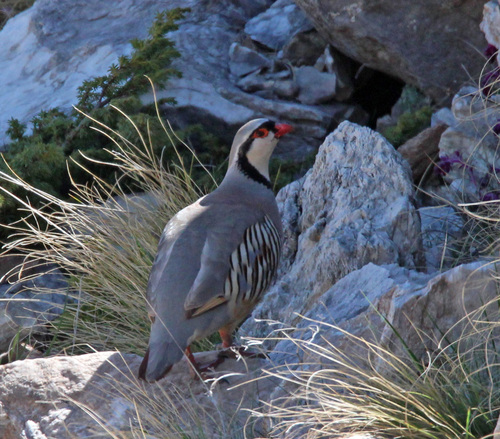
Rock Partridge (Alectoris graeca) Rock Partridge

Media

Loading…

In short

The Red-legged Partridge and Rock Partridge are similar in appearance but can be distinguished by habitat preference and subtle plumage differences. The Red-legged Partridge is more commonly found in open, lowland areas, while the Rock Partridge prefers rocky, mountainous terrain.

Identification tips

  1. Habitat: Check the surrounding environment; lowland areas suggest Red-legged, while rocky, elevated terrain suggests Rock Partridge. 2. Leg Color: Look for the intensity of red on the legs; more pronounced in Red-legged Partridge. 3. Plumage Tone: Note the overall warmth of the plumage; Red-legged Partridge appears warmer. 4. Vocalization: Listen for subtle differences in call rhythm and tone, though this requires experience.

Size

Both species are similar in size, typical of the Alectoris genus, with no significant differences in structure such as bill or tail length.

Plumage

The Red-legged Partridge has a more pronounced red coloration on the legs and a slightly warmer overall plumage tone. The Rock Partridge tends to have a more muted, grayish tone and less distinct leg coloration.

Behaviour

Both species exhibit similar behaviors typical of partridges, such as ground foraging and forming small coveys. There are no significant behavioral differences noted.

Habitat

The Red-legged Partridge is found in open, lowland areas such as farmland and grasslands, while the Rock Partridge is more often in rocky, mountainous regions.

Voice

Vocalizations are similar, with both species producing a series of chuckling calls. However, slight differences in tone and rhythm may be noted by experienced listeners.

Submit a better description

Use the same sections as the comparison. Your text is published immediately.

The Red-legged Partridge and Rock Partridge are similar in appearance but can be distinguished by habitat preference and subtle plumage differences. The Red-legged Partridge is more commonly found in open, lowland areas, while the Rock Partridge prefers rocky, mountainous terrain.

  1. Habitat: Check the surrounding environment; lowland areas suggest Red-legged, while rocky, elevated terrain suggests Rock Partridge. 2. Leg Color: Look for the intensity of red on the legs; more pronounced in Red-legged Partridge. 3. Plumage Tone: Note the overall warmth of the plumage; Red-legged Partridge appears warmer. 4. Vocalization: Listen for subtle differences in call rhythm and tone, though this requires experience.

Both species are similar in size, typical of the Alectoris genus, with no significant differences in structure such as bill or tail length.

The Red-legged Partridge has a more pronounced red coloration on the legs and a slightly warmer overall plumage tone. The Rock Partridge tends to have a more muted, grayish tone and less distinct leg coloration.

Both species exhibit similar behaviors typical of partridges, such as ground foraging and forming small coveys. There are no significant behavioral differences noted.

The Red-legged Partridge is found in open, lowland areas such as farmland and grasslands, while the Rock Partridge is more often in rocky, mountainous regions.

Vocalizations are similar, with both species producing a series of chuckling calls. However, slight differences in tone and rhythm may be noted by experienced listeners.

Discard your changes?

You have unsaved edits. If you leave now, those changes will be lost.

Red-legged Partridge · Rock Partridge · My Tricky Birds