Red-necked Phalarope vs Terek Sandpiper
Phalaropus lobatus versus Xenus cinereus
Play a quiz with Red-necked Phalarope and Terek Sandpiper

Red-necked Phalarope
Terek Sandpiper
In short
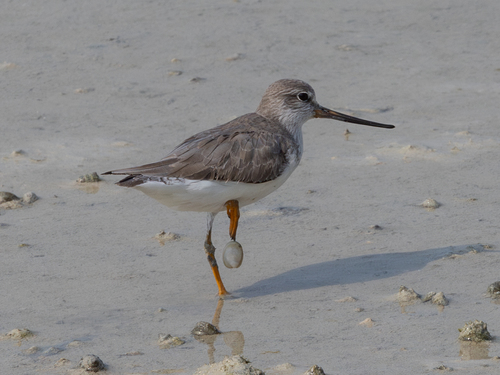
The Red-necked Phalarope and Terek Sandpiper can be distinguished by their bill shape and behavior. The Red-necked Phalarope has a fine, straight bill and is known for spinning in circles while feeding, whereas the Terek Sandpiper has a long, upcurved bill and dashes across mudflats while feeding.
Identification tips
- Bill shape: Red-necked Phalarope has a fine, straight bill; Terek Sandpiper has a long, upcurved bill.
- Behavior: Look for spinning behavior in phalaropes and dashing or scything in Terek Sandpipers.
- Plumage: In non-breeding plumage, check for the black eye-patch in Red-necked Phalaropes.
- Habitat: Consider the location; phalaropes are more likely in open water, while Terek Sandpipers are on mudflats.
Size
The Terek Sandpiper is generally larger and more robust than the slender Red-necked Phalarope.
Plumage
Both species have grayish tones, but the Red-necked Phalarope in non-breeding plumage has a striking black eye-patch, whereas the Terek Sandpiper lacks this feature and has a more uniform appearance.
Behaviour
Red-necked Phalaropes spin in tight circles to feed, while Terek Sandpipers dash across mudflats or wade in shallow water, using their unique upcurved bill to scythe the surface.
Habitat
Red-necked Phalaropes are often found in pelagic environments or hypersaline lakes during migration, while Terek Sandpipers prefer intertidal flats near mangroves.