Birdr

Red-shouldered Hawk vs Short-tailed Hawk

Buteo lineatus versus Buteo brachyurus

Play a quiz with Red-shouldered Hawk and Short-tailed Hawk
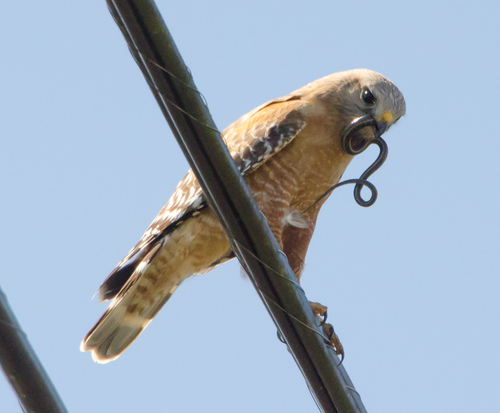
Red-shouldered Hawk (Buteo lineatus) Red-shouldered Hawk
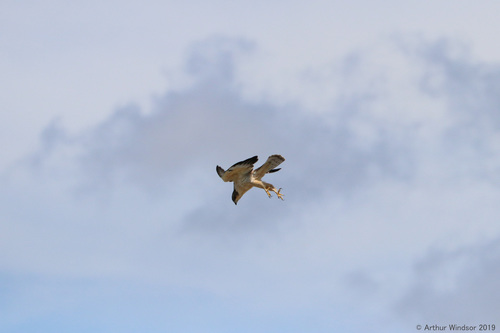
Short-tailed Hawk (Buteo brachyurus) Short-tailed Hawk

Media

Loading…

In short

The most reliable field mark between Red-shouldered Hawk and Short-tailed Hawk is the presence of rufous barring and red 'shoulders' on the Red-shouldered Hawk, visible both in flight and when perched, versus the Short-tailed Hawk's lack of such coloration and its much shorter tail. Juvenile Red-shouldered Hawks have long, narrowly banded tails and show pale crescent-shaped markings near the wingtips in flight, while Short-tailed Hawks are best identified by their compact, short-tailed silhouette and variable plumage, often seen only when soaring high. Structure and flight style also differ: Red-shouldered Hawks appear lankier and more Accipiter-like in flight, while Short-tailed Hawks are more compact and kite-like. Both species can occur in Florida, but the Short-tailed Hawk is much rarer and typically detected only in flight.

Identification tips

  1. Tail length and pattern (all ages): Red-shouldered Hawk has a long tail with narrow white bands; Short-tailed Hawk has a distinctly short tail with broader bands or sometimes appearing almost unmarked from a distance.
  2. Wing crescents (juvenile Red-shouldered): In flight, juvenile Red-shouldered Hawks show pale crescent-shaped markings near the wingtips (on the primaries), which are absent in Short-tailed Hawk of any age or morph.
  3. Red 'shoulders' (adult Red-shouldered): Adults show a rufous patch on the upperwing coverts ('shoulders'), visible both perched and in flight. Short-tailed Hawk never shows this mark.
  4. Chest and belly color (adult Red-shouldered): Look for reddish barring on the chest and belly in adult Red-shouldered; Short-tailed Hawk (light morph) has white underparts, and dark morph is uniformly dark below.
  5. Upperwing pattern (adult Red-shouldered): Red-shouldered shows heavily barred upperwings with pale spots; Short-tailed Hawk has plainer upperwings without strong barring or spotting.
  6. Flight silhouette: Red-shouldered Hawk is lankier, with a longer tail and wings, and often flies with more flapping and a slightly Accipiter-like jizz. Short-tailed Hawk is compact, with a short tail and broad wings, often seen soaring or kiting high overhead.
  7. Perched posture: Red-shouldered Hawk often perches in the open, showing its long tail and red shoulders. Short-tailed Hawk is secretive when perched, often hidden in dense canopy, and rarely offers good perched views.
  8. Plumage variability (Short-tailed): Short-tailed Hawk is highly variable, with both dark and light morphs. If you see a small, short-tailed buteo soaring high, check for lack of rufous and overall compactness.
  9. Habitat (Florida context): In Florida, Red-shouldered Hawk is common in wooded and semi-open areas; Short-tailed Hawk is rare, mostly seen in open country or at woodland edges, and almost always detected in flight.
  10. Relative abundance: If you see a medium-sized buteo in Florida, it is much more likely to be Red-shouldered Hawk unless you are specifically scanning for Short-tailed Hawk in known areas.
  11. Leg color: Red-shouldered Hawk has long yellow legs, which may be visible when perched; this is not a reliable mark for Short-tailed Hawk due to its secretive habits.
  12. Migration and season: Red-shouldered Hawk is resident or short-distance migrant; Short-tailed Hawk is non-migratory in Florida but rare and local.
  13. Voice: Not diagnostic between these two; both are usually silent when soaring.
  14. Size impression: Red-shouldered Hawk appears larger and longer-tailed; Short-tailed Hawk is smaller and more compact, especially in flight.
  15. Common confusion: Juvenile Red-shouldered Hawks are most likely to be mistaken for Short-tailed Hawk, but always check for tail length, wing crescents, and rufous barring to separate them.

Size

Red-shouldered Hawk is a medium-sized Buteo, averaging about 625.5 g in body mass, with a wingspan of 90–127 cm and a notably long tail for a Buteo. Short-tailed Hawk is smaller and more compact overall, with a distinctly shorter tail and a more compact, less lanky structure. In the field, Red-shouldered Hawk will usually appear larger and longer-winged, especially when perched or soaring at moderate distance, while Short-tailed Hawk often looks petite and stubby-tailed, especially when seen soaring high overhead. Exact mass for Short-tailed Hawk is not provided, but it is generally considered smaller than Red-shouldered Hawk.

Plumage

Juvenile Red-shouldered Hawks are most likely to be confused with Short-tailed Hawks, but they can be separated by their long, narrowly banded tails and the presence of pale crescent-shaped markings near the wingtips (visible in flight). Adults have brownish heads, rufous barred chests, and red 'shoulders'—the latter visible when perched or at rest. Their upperparts are dark with pale spots, and the tail is long with narrow white bands. Short-tailed Hawk, in contrast, lacks the rufous barring and red shoulder patch entirely. Its plumage is highly variable (dark and light morphs), but the tail is always short and the overall look is compact. In light morphs, the underparts are mostly white with dark flight feathers, while dark morphs are mostly dark brown to blackish. The Short-tailed Hawk's upperwing lacks the heavy barring and pale spotting of Red-shouldered Hawk. When perched, Short-tailed Hawk is often hidden in dense canopy, making plumage details hard to see.

Behaviour

Red-shouldered Hawk often soars with a more flapping, Accipiter-like flight style and is more likely to be seen perched in the open, especially along woodland edges or near water. Short-tailed Hawk is primarily an aerial hunter, rarely seen perched in the open, and is best detected when soaring high overhead, sometimes 'kiting' into the wind with stationary wings. Short-tailed Hawk attacks prey with steep, vertical stoops and is much more secretive when perched. Red-shouldered Hawk is more likely to be seen soaring at lower altitudes or gliding between perches.

Habitat

Red-shouldered Hawk is common in eastern North America, California, and parts of Mexico, favoring woodlands, especially near water, and is a permanent resident in much of its range. Short-tailed Hawk is rare and local in Florida (where confusion is most likely), and otherwise found in tropical and subtropical Americas. It prefers borders between wooded and open areas, but is much more difficult to detect unless soaring. In Florida, Red-shouldered Hawk is abundant and widespread, while Short-tailed Hawk is considered Critically Imperiled and is rarely seen except by dedicated sky-scanning.

Submit a better description

Use the same sections as the comparison. Your text is published immediately.

The most reliable field mark between Red-shouldered Hawk and Short-tailed Hawk is the presence of rufous barring and red 'shoulders' on the Red-shouldered Hawk, visible both in flight and when perched, versus the Short-tailed Hawk's lack of such coloration and its much shorter tail. Juvenile Red-shouldered Hawks have long, narrowly banded tails and show pale crescent-shaped markings near the wingtips in flight, while Short-tailed Hawks are best identified by their compact, short-tailed silhouette and variable plumage, often seen only when soaring high. Structure and flight style also differ: Red-shouldered Hawks appear lankier and more Accipiter-like in flight, while Short-tailed Hawks are more compact and kite-like. Both species can occur in Florida, but the Short-tailed Hawk is much rarer and typically detected only in flight.

  1. Tail length and pattern (all ages): Red-shouldered Hawk has a long tail with narrow white bands; Short-tailed Hawk has a distinctly short tail with broader bands or sometimes appearing almost unmarked from a distance.
  2. Wing crescents (juvenile Red-shouldered): In flight, juvenile Red-shouldered Hawks show pale crescent-shaped markings near the wingtips (on the primaries), which are absent in Short-tailed Hawk of any age or morph.
  3. Red 'shoulders' (adult Red-shouldered): Adults show a rufous patch on the upperwing coverts ('shoulders'), visible both perched and in flight. Short-tailed Hawk never shows this mark.
  4. Chest and belly color (adult Red-shouldered): Look for reddish barring on the chest and belly in adult Red-shouldered; Short-tailed Hawk (light morph) has white underparts, and dark morph is uniformly dark below.
  5. Upperwing pattern (adult Red-shouldered): Red-shouldered shows heavily barred upperwings with pale spots; Short-tailed Hawk has plainer upperwings without strong barring or spotting.
  6. Flight silhouette: Red-shouldered Hawk is lankier, with a longer tail and wings, and often flies with more flapping and a slightly Accipiter-like jizz. Short-tailed Hawk is compact, with a short tail and broad wings, often seen soaring or kiting high overhead.
  7. Perched posture: Red-shouldered Hawk often perches in the open, showing its long tail and red shoulders. Short-tailed Hawk is secretive when perched, often hidden in dense canopy, and rarely offers good perched views.
  8. Plumage variability (Short-tailed): Short-tailed Hawk is highly variable, with both dark and light morphs. If you see a small, short-tailed buteo soaring high, check for lack of rufous and overall compactness.
  9. Habitat (Florida context): In Florida, Red-shouldered Hawk is common in wooded and semi-open areas; Short-tailed Hawk is rare, mostly seen in open country or at woodland edges, and almost always detected in flight.
  10. Relative abundance: If you see a medium-sized buteo in Florida, it is much more likely to be Red-shouldered Hawk unless you are specifically scanning for Short-tailed Hawk in known areas.
  11. Leg color: Red-shouldered Hawk has long yellow legs, which may be visible when perched; this is not a reliable mark for Short-tailed Hawk due to its secretive habits.
  12. Migration and season: Red-shouldered Hawk is resident or short-distance migrant; Short-tailed Hawk is non-migratory in Florida but rare and local.
  13. Voice: Not diagnostic between these two; both are usually silent when soaring.
  14. Size impression: Red-shouldered Hawk appears larger and longer-tailed; Short-tailed Hawk is smaller and more compact, especially in flight.
  15. Common confusion: Juvenile Red-shouldered Hawks are most likely to be mistaken for Short-tailed Hawk, but always check for tail length, wing crescents, and rufous barring to separate them.

Red-shouldered Hawk is a medium-sized Buteo, averaging about 625.5 g in body mass, with a wingspan of 90–127 cm and a notably long tail for a Buteo. Short-tailed Hawk is smaller and more compact overall, with a distinctly shorter tail and a more compact, less lanky structure. In the field, Red-shouldered Hawk will usually appear larger and longer-winged, especially when perched or soaring at moderate distance, while Short-tailed Hawk often looks petite and stubby-tailed, especially when seen soaring high overhead. Exact mass for Short-tailed Hawk is not provided, but it is generally considered smaller than Red-shouldered Hawk.

Juvenile Red-shouldered Hawks are most likely to be confused with Short-tailed Hawks, but they can be separated by their long, narrowly banded tails and the presence of pale crescent-shaped markings near the wingtips (visible in flight). Adults have brownish heads, rufous barred chests, and red 'shoulders'—the latter visible when perched or at rest. Their upperparts are dark with pale spots, and the tail is long with narrow white bands. Short-tailed Hawk, in contrast, lacks the rufous barring and red shoulder patch entirely. Its plumage is highly variable (dark and light morphs), but the tail is always short and the overall look is compact. In light morphs, the underparts are mostly white with dark flight feathers, while dark morphs are mostly dark brown to blackish. The Short-tailed Hawk's upperwing lacks the heavy barring and pale spotting of Red-shouldered Hawk. When perched, Short-tailed Hawk is often hidden in dense canopy, making plumage details hard to see.

Red-shouldered Hawk often soars with a more flapping, Accipiter-like flight style and is more likely to be seen perched in the open, especially along woodland edges or near water. Short-tailed Hawk is primarily an aerial hunter, rarely seen perched in the open, and is best detected when soaring high overhead, sometimes 'kiting' into the wind with stationary wings. Short-tailed Hawk attacks prey with steep, vertical stoops and is much more secretive when perched. Red-shouldered Hawk is more likely to be seen soaring at lower altitudes or gliding between perches.

Red-shouldered Hawk is common in eastern North America, California, and parts of Mexico, favoring woodlands, especially near water, and is a permanent resident in much of its range. Short-tailed Hawk is rare and local in Florida (where confusion is most likely), and otherwise found in tropical and subtropical Americas. It prefers borders between wooded and open areas, but is much more difficult to detect unless soaring. In Florida, Red-shouldered Hawk is abundant and widespread, while Short-tailed Hawk is considered Critically Imperiled and is rarely seen except by dedicated sky-scanning.

Discard your changes?

You have unsaved edits. If you leave now, those changes will be lost.

Red-shouldered Hawk · Short-tailed Hawk · My Tricky Birds