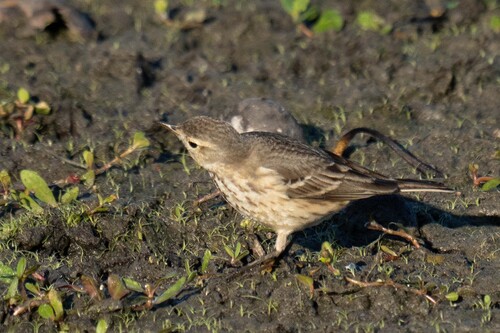
Red-throated Pipit vs Buff-bellied Pipit
Anthus cervinus versus Anthus rubescens
Play a quiz with Red-throated Pipit and Buff-bellied Pipit
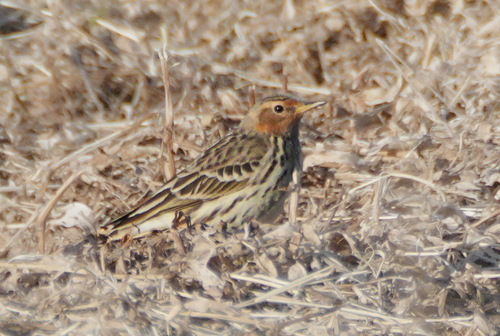
Red-throated Pipit
Buff-bellied Pipit
In short
The Red-throated Pipit (Anthus cervinus) and Buff-bellied Pipit (Anthus rubescens) can be distinguished primarily by plumage and habitat preferences. The Red-throated Pipit often shows a distinctive red throat in breeding plumage, while the Buff-bellied Pipit is more uniformly brown with a buffy belly. Both species are similar in size and structure, making plumage and habitat the most reliable field marks.
Identification tips
- Look for the red throat patch on the Red-throated Pipit during breeding season.
- Note the buffy belly of the Buff-bellied Pipit.
- Consider habitat: tundra and wet meadows for Red-throated Pipit, more varied open habitats for Buff-bellied Pipit.
- Listen carefully for subtle differences in calls if visible features are inconclusive.
Size
Both species are similar in size, typical of pipits, with slender builds and long tails.
Plumage
In breeding plumage, the Red-throated Pipit has a distinctive red throat patch, whereas the Buff-bellied Pipit lacks this and is more uniformly brown with a buffy belly. In nonbreeding plumage, both species are more subdued, but the Red-throated Pipit may still show some reddish tones on the throat.
Behaviour
Both species exhibit typical pipit behavior, such as walking and scanning the ground for invertebrates. They may run towards prey before pecking.
Habitat
The Red-throated Pipit is often found in tundra and wet meadows during breeding, while the Buff-bellied Pipit (American Pipit) occupies a variety of open habitats including beaches and agricultural fields during nonbreeding seasons.
Voice
Vocalizations are not the most reliable distinguishing feature in the field, as both species have similar calls. However, the Red-throated Pipit's call is often described as a high-pitched 'tseep', while the Buff-bellied Pipit's call is a bit more musical.