
Red-throated Thrush vs Indochinese Blue Flycatcher
Turdus ruficollis versus Cyornis sumatrensis
Play a quiz with Red-throated Thrush and Indochinese Blue Flycatcher
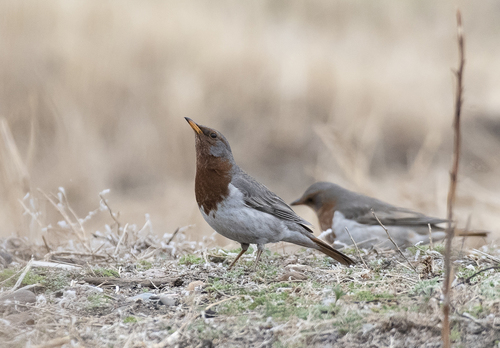 Red-throated Thrush
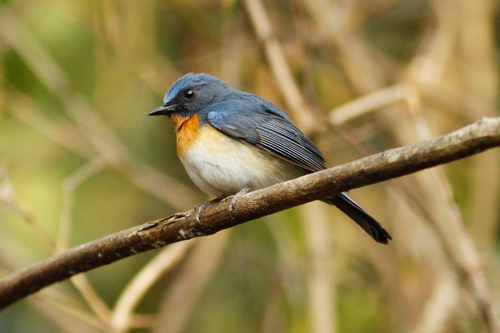 Indochinese Blue Flycatcher
In short
The most reliable field mark to separate Red-throated Thrush from Indochinese Blue Flycatcher is overall structure and plumage: Red-throated Thrush is a large, plain grey thrush with reddish underwings and, in adult males, a distinctive red throat, while Indochinese Blue Flycatcher is a much smaller, compact bird with blue upperparts and orange on the breast. Immature and female Red-throated Thrushes lack the red throat but show black-streaked underparts, never blue. In flight, the thrush’s size and reddish underwing contrast sharply with the flycatcher’s much smaller, more delicate silhouette and lack of rufous tones. If you see a large, plain-backed bird with reddish tones in the wings or throat, it is the thrush; a small, blue-and-orange bird is the flycatcher.
Identification tips
- Size and Structure: Red-throated Thrush is much larger and bulkier than Indochinese Blue Flycatcher. If the bird appears thrush-sized, it is not the flycatcher.
- Bill Shape: The thrush has a strong, straight bill; the flycatcher’s bill is finer and more delicate, suited for flycatching.
- Tail Length and Shape: The thrush has a longer, more squared tail; the flycatcher’s tail is shorter and may appear slightly rounded.
- Adult Male Plumage: Look for a red throat in adult male Red-throated Thrush—this is never matched by the flycatcher.
- Female/Immature Plumage: Female and immature thrushes lack the red throat but show black-streaked underparts and plain grey upperparts; flycatchers never show this combination.
- Underwing Color in Flight: Red-throated Thrush shows reddish underwings, especially visible in flight or wing-flicking; the flycatcher’s underwing is not reddish.
- Upperparts Color: Thrushes are plain grey above; flycatchers (especially males) are blue above, with females/immatures showing at least some blue or greyish-blue tones.
- Breast Color: Flycatchers have orange on the breast (males especially), never seen in the thrush. Thrushes have pale or streaked underparts.
- Behavior: Thrushes often walk or hop on the ground; flycatchers sally for insects from perches and are more restless.
- Habitat: If seen in dense, humid forest, flycatcher is more likely; open woodland or edge habitats favor the thrush.
- Posture: Thrushes stand upright and alert; flycatchers are more horizontal, often flicking tail and wings.
- Flight Style: Thrushes have strong, direct flight; flycatchers are more fluttery and agile.
- Context: Red-throated Thrush is a rare vagrant in western Europe—double-check any record there.
- No Blue or Orange in Thrush: If you see blue upperparts or orange on the breast, rule out Red-throated Thrush.
- No Red Throat in Flycatcher: If you see a red throat, it is not the flycatcher, regardless of age or sex.
Size
Red-throated Thrush is a large thrush, substantially bigger and bulkier than Indochinese Blue Flycatcher. The thrush has a robust body, longer tail, and a strong, straight bill typical of Turdus thrushes. In contrast, Indochinese Blue Flycatcher is much smaller, with a compact, flycatcher-like build, shorter tail, and a finer bill. Even at a distance, the size difference is striking: the thrush is closer to a Eurasian Blackbird in size, while the flycatcher is more akin to a European Robin or even smaller.
Plumage
For all ages, Red-throated Thrush shows a plain grey back and reddish underwings, which are visible in flight or when the bird flicks its wings. Adult males have a diagnostic red throat; females and immatures lack this but have black-streaked underparts, never blue or orange. Indochinese Blue Flycatcher, regardless of age or sex, never shows grey upperparts or rufous underwings. Instead, males have blue upperparts and orange on the breast, while females and immatures are duller but retain some blue and orange hues. There is no overlap in the presence of blue or orange on the upperparts or breast between the two species. The thrush’s underwing is reddish, a key flight mark absent in the flycatcher.
Behaviour
Red-throated Thrush typically forages on the ground or in low shrubs, often hopping and moving with the upright, alert posture of a Turdus thrush. It may perch in open areas or on exposed branches. Indochinese Blue Flycatcher is more active and agile, often sallying for insects from low perches, flicking its wings and tail, and generally behaving with the quick, darting movements typical of flycatchers. The thrush is more likely to be seen walking or standing still; the flycatcher is restless and frequently moves between perches.
Habitat
Red-throated Thrush breeds in open woodlands and forest edges of East Siberia and northern Asia, wintering in West China, Myanmar, and Northeast India; it is a rare vagrant to western Europe. Indochinese Blue Flycatcher is found in forested habitats from southern Myanmar and the Malay Peninsula to Indochina and northeastern Sumatra, often in denser, more humid forest or secondary growth. Their ranges only overlap in wintering areas, and habitat preferences differ: thrushes prefer open or edge habitats, flycatchers denser forest or thickets.
Red-throated Thrush · Indochinese Blue Flycatcher · My Tricky Birds