
Roadside Hawk vs Harris's Hawk
Rupornis magnirostris versus Parabuteo unicinctus
Play a quiz with Roadside Hawk and Harris's Hawk
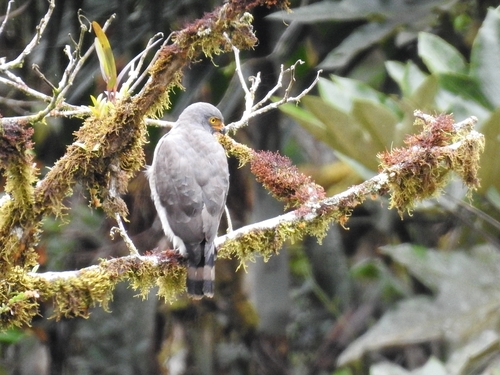 Roadside Hawk
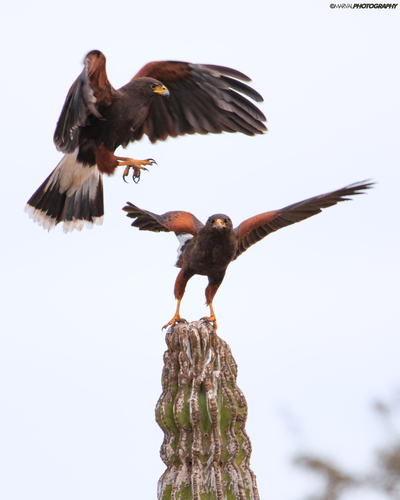 Harris's Hawk
In short
The most reliable field mark to separate Roadside Hawk from Harris's Hawk is the juvenile wing and underpart pattern: juvenile Harris's Hawks show buffy, heavily streaked underparts and a pale panel on the underwing, while Roadside Hawks (all ages) show brown or grey upperparts with barred brown-and-white underparts and a rufous tinge on the wings in flight. Harris's Hawk is much larger and bulkier, with a distinctive white base and tip to the tail (broadest in adults), while Roadside Hawk is smaller, with a relatively long tail and short wings, and lacks the bold white tail pattern. In flight, Roadside Hawk's proportions are more compact and its tail appears longer relative to the wings. Both species can be seen soaring, but Harris's Hawk often perches in groups and shows more cooperative behavior. Vocalizations differ, but are less likely to be confused than plumage and structure.
Identification tips
- Juvenile Harris's Hawk in flight: Look for buffy underparts heavily streaked with brown, a pale panel on the underwing (whitish primaries except at tips), and a paler tail band. Roadside Hawk juveniles do not show this pattern; their underparts are barred brown and white, and the wings may show rufous but not a pale panel.
- Adult Harris's Hawk tail pattern: Broad white band at both the base and tip of the tail is diagnostic; Roadside Hawk has a tail with four or five grey bars but lacks bold white at base or tip.
- Roadside Hawk wing and tail shape: In flight, note the relatively long tail and short, rounded wings; Harris's Hawk has longer wings and tail, but the overall impression is of a much larger, broader bird.
- Rufous on Roadside Hawk wings: Especially in flight, many subspecies show a touch of rufous on the wings, which is absent in Harris's Hawk.
- Underpart barring: Roadside Hawk (all ages) shows brown-and-white barring on the lower breast and underparts; Harris's Hawk adults are solid dark below, juveniles are streaked but not barred.
- Eye color: Adult Roadside Hawks have whitish or yellow eyes, which can be a subtle but useful mark at close range; Harris's Hawk eye color is not specified here.
- Bill size: Roadside Hawk has a relatively large beak for its size, but this is subtle and not usually diagnostic in the field.
- Group behavior: Harris's Hawks are often seen in groups, especially perched or hunting together; Roadside Hawks are typically solitary or in pairs.
- Relative size: Harris's Hawk is more than twice the mass of Roadside Hawk and appears much larger and bulkier in all contexts.
- Habitat context: Harris's Hawk prefers arid, open country with scattered trees or cacti, while Roadside Hawk is more generalist and common along roadsides and in open woodlands.
- Vocalization: Roadside Hawk's high-pitched squeak is distinctive; Harris's Hawk does not give this call.
- Perched posture: Roadside Hawk often appears compact with a long tail; Harris's Hawk is larger, more robust, and often perches with other hawks.
- Flight style: Both soar, but Roadside Hawk does not hover and appears more compact in flight; Harris's Hawk has broader wings and a heavier, more powerful flight.
- Tail pattern in flight: Always check for the white base and tip (Harris's) vs. barred tail (Roadside); this is reliable at all ages.
- Subspecies variation: Be aware that Roadside Hawk shows some plumage variation among subspecies (brown to grey upperparts), but the basic pattern of barred underparts and lack of bold white tail bands holds throughout.
Size
Harris's Hawk is significantly larger and heavier than Roadside Hawk, with an average adult mass of about 843.7 g [wikidata], compared to Roadside Hawk's much smaller size (31–41 cm length, 250–300 g) [wikipedia]. Harris's Hawk appears medium-large and robust, while Roadside Hawk is compact and noticeably smaller, with males even lighter than females. This size difference is usually obvious in the field, especially if both species are seen in the same area.
Plumage
Juvenile Harris's Hawks are distinctive: they have heavily streaked white or buff underparts, and in flight, their underwings are buff with brown streaking and a pale panel formed by whitish primary feathers except at the tips. Their tail band is paler than adults, and the overall effect is much lighter and more patterned than adult Harris's Hawks, which are mostly solid dark brown with chestnut shoulders and thighs, and bold white at the base and tip of the tail. Roadside Hawks, regardless of age, show brown or grey upperparts, barred brown-and-white underparts, and a tail with four or five grey bars but no bold white base or tip. In flight, Roadside Hawks often show a touch of rufous on the wings, especially in most subspecies, and their eyes are whitish or yellow in adults. The Harris's Hawk's white tail base and tip are always present, but are broadest in adults and may be less distinct in juveniles. The underwing of adult Harris's Hawk is completely dark (P. u. harrisi) or patterned and lighter (P. u. unicinctus), but never shows the rufous of Roadside Hawk. Sexes are similar in both species, but Roadside Hawk males are about 20% smaller.
Behaviour
Harris's Hawks are well known for their cooperative hunting and social behavior, often seen in groups of two or three birds, sometimes with helpers at the nest. They perch conspicuously, often together, and may hunt in packs. Roadside Hawks are typically solitary or in pairs, and are more likely to be seen perched alone or soaring. Both species perch in open areas, but Harris's Hawk's group behavior is distinctive and rarely matched by Roadside Hawk.
Habitat
Roadside Hawk is often the most common raptor in its range in the Americas and is frequently seen along roadsides, open woodlands, and edges. Harris's Hawk ranges from the southwestern US to South America, nesting in small trees, shrubs, or cacti, and is more typical of arid or semi-arid open country, including deserts and scrub. Both can occur in open habitats, but Harris's Hawk is more tied to drier, open landscapes, while Roadside Hawk is more generalist and common in a wider variety of open and edge habitats.
Voice
Roadside Hawk gives a very high-pitched, piercing squeak, which is distinctive in its range. Harris's Hawk vocalizations are not described in detail here, but are not likely to be confused with the Roadside Hawk's squeak. Voice is less likely to be the source of confusion than plumage or structure.