Birdr

Rock Dove vs Collared Dove

Columba livia versus Streptopelia decaocto

Play a quiz with Rock Dove and Collared Dove

Rock Dove (Columba livia) Rock Dove
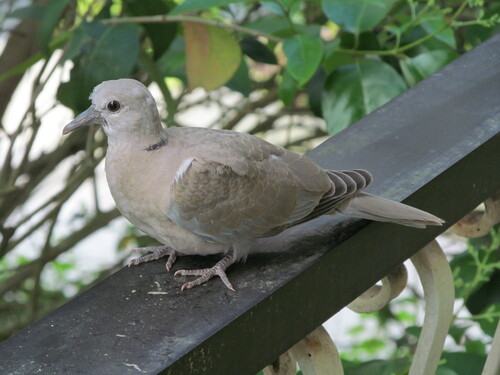
Collared Dove (Streptopelia decaocto) Collared Dove

Media

Loading…

In short

The Rock Dove (Columba livia) and the Eurasian Collared-Dove (Streptopelia decaocto) can be distinguished primarily by their tail and neck markings. The Collared-Dove has a distinctive black 'collar' on the back of its neck and a squared tail with broad white tips, while the Rock Dove lacks these features and has a more varied plumage due to its polymorphic nature.

Identification tips

  1. Look for the black 'collar' on the Eurasian Collared-Dove's neck. 2. Check tail shape: squared with white tips for Collared-Dove, rounded for Rock Dove. 3. Note plumage uniformity: Collared-Dove is more consistently pale gray. 4. Listen for vocalizations: distinct three-part cooing for Collared-Dove.

Size

Both species are similar in size, but the Eurasian Collared-Dove is slightly smaller and more slender than the Rock Dove.

Plumage

Rock Doves exhibit highly variable plumage, often with iridescent neck feathers and a generally gray body. In contrast, the Eurasian Collared-Dove is more uniform in color, typically pale gray with a characteristic black collar on the neck and white-tipped tail feathers.

Behaviour

Both species are often seen in urban areas and are comfortable around humans. Rock Doves are known for their flocking behavior, while Eurasian Collared-Doves are often seen in pairs or small groups.

Habitat

Rock Doves are commonly found in cities and rural areas worldwide, often nesting on buildings and cliffs. Eurasian Collared-Doves prefer suburban and rural areas, often near human habitation, and have rapidly expanded their range in recent decades.

Voice

The Eurasian Collared-Dove has a distinct three-part cooing sound, often described as 'coo-COO-coo,' which is different from the variable cooing of the Rock Dove.

Submit a better description

Use the same sections as the comparison. Your text is published immediately.

The Rock Dove (Columba livia) and the Eurasian Collared-Dove (Streptopelia decaocto) can be distinguished primarily by their tail and neck markings. The Collared-Dove has a distinctive black 'collar' on the back of its neck and a squared tail with broad white tips, while the Rock Dove lacks these features and has a more varied plumage due to its polymorphic nature.

  1. Look for the black 'collar' on the Eurasian Collared-Dove's neck. 2. Check tail shape: squared with white tips for Collared-Dove, rounded for Rock Dove. 3. Note plumage uniformity: Collared-Dove is more consistently pale gray. 4. Listen for vocalizations: distinct three-part cooing for Collared-Dove.

Both species are similar in size, but the Eurasian Collared-Dove is slightly smaller and more slender than the Rock Dove.

Rock Doves exhibit highly variable plumage, often with iridescent neck feathers and a generally gray body. In contrast, the Eurasian Collared-Dove is more uniform in color, typically pale gray with a characteristic black collar on the neck and white-tipped tail feathers.

Both species are often seen in urban areas and are comfortable around humans. Rock Doves are known for their flocking behavior, while Eurasian Collared-Doves are often seen in pairs or small groups.

Rock Doves are commonly found in cities and rural areas worldwide, often nesting on buildings and cliffs. Eurasian Collared-Doves prefer suburban and rural areas, often near human habitation, and have rapidly expanded their range in recent decades.

The Eurasian Collared-Dove has a distinct three-part cooing sound, often described as 'coo-COO-coo,' which is different from the variable cooing of the Rock Dove.

Discard your changes?

You have unsaved edits. If you leave now, those changes will be lost.

Rock Dove · Collared Dove · My Tricky Birds