Birdr

Rock Dove vs Stock Dove

Columba livia versus Columba oenas

Play a quiz with Rock Dove and Stock Dove

Rock Dove (Columba livia) Rock Dove
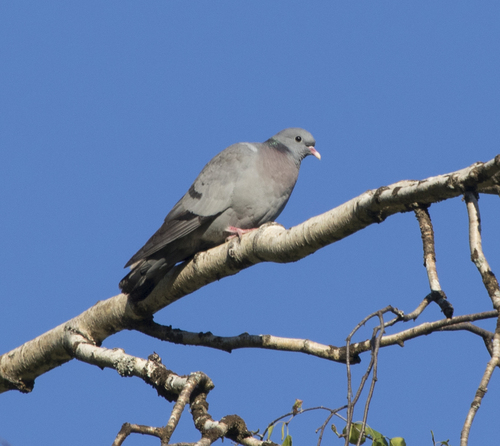
Stock Dove (Columba oenas) Stock Dove

Media

Loading…

In short

The Rock Dove (Columba livia) and Stock Dove (Columba oenas) are similar in size and structure but can be distinguished by plumage and habitat preferences. Rock Doves, often seen in urban areas, display a wide range of plumage variations due to feral populations, while Stock Doves have a more uniform appearance with a distinctive lack of white markings on the wings.

Identification tips

1. Look for white wing bars on Rock Doves, absent in Stock Doves. 2. Observe habitat: Rock Doves are more urban, Stock Doves prefer rural settings. 3. Listen for the Stock Dove's soft 'cooing' call, distinct from the Rock Dove's varied sounds.

Size

Both species are similar in size, with the Stock Dove being slightly more compact.

Plumage

Rock Doves exhibit a wide variety of plumage due to their feral nature, often showing iridescent neck feathers and two black wing bars. Stock Doves are more uniform, typically grey with a subtle green neck patch and lack the white wing bars seen in many Rock Doves.

Behaviour

Both species can be seen feeding on the ground, but Rock Doves are more commonly seen in urban environments, often in larger flocks.

Habitat

Rock Doves are commonly found in urban areas, while Stock Doves prefer open countryside, often nesting in tree holes or old buildings.

Voice

The Stock Dove has a distinctive soft, 'cooing' call, which is less varied than the Rock Dove's vocalizations.

Submit a better description

Use the same sections as the comparison. Your text is published immediately.

The Rock Dove (Columba livia) and Stock Dove (Columba oenas) are similar in size and structure but can be distinguished by plumage and habitat preferences. Rock Doves, often seen in urban areas, display a wide range of plumage variations due to feral populations, while Stock Doves have a more uniform appearance with a distinctive lack of white markings on the wings.

1. Look for white wing bars on Rock Doves, absent in Stock Doves. 2. Observe habitat: Rock Doves are more urban, Stock Doves prefer rural settings. 3. Listen for the Stock Dove's soft 'cooing' call, distinct from the Rock Dove's varied sounds.

Both species are similar in size, with the Stock Dove being slightly more compact.

Rock Doves exhibit a wide variety of plumage due to their feral nature, often showing iridescent neck feathers and two black wing bars. Stock Doves are more uniform, typically grey with a subtle green neck patch and lack the white wing bars seen in many Rock Doves.

Both species can be seen feeding on the ground, but Rock Doves are more commonly seen in urban environments, often in larger flocks.

Rock Doves are commonly found in urban areas, while Stock Doves prefer open countryside, often nesting in tree holes or old buildings.

The Stock Dove has a distinctive soft, 'cooing' call, which is less varied than the Rock Dove's vocalizations.

Discard your changes?

You have unsaved edits. If you leave now, those changes will be lost.

Rock Dove · Stock Dove · My Tricky Birds