
Rock Pipit vs Buff-bellied Pipit
Anthus petrosus versus Anthus rubescens
Play a quiz with Rock Pipit and Buff-bellied Pipit
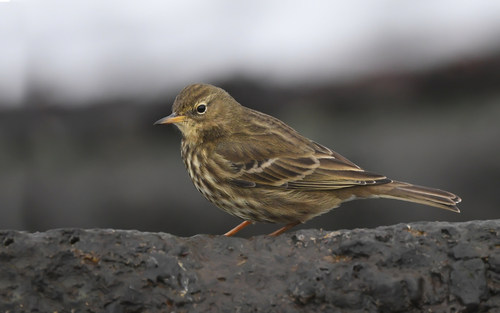 Rock Pipit
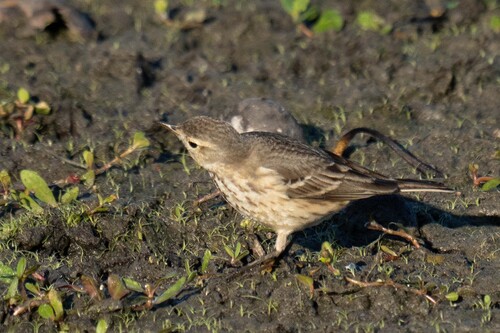 Buff-bellied Pipit
In short
The most reliable field mark between Rock Pipit and Buff-bellied Pipit is the color and definition of the streaking below and the tone of the upperparts: Rock Pipit is generally darker and more olive-toned above, with blurry, poorly defined streaks on the underparts, while Buff-bellied Pipit is paler and greyer above, with finer, more distinct streaking and a paler, whitish belly. Juvenile and immature birds of both species can look similar, but Rock Pipit’s overall duskier appearance and darker legs help separate it. In flight, Rock Pipit shows dusky—not white—outer tail feathers, a key point if seen well. Habitat is also a strong clue: Rock Pipit is almost always on rocky European coasts, while Buff-bellied Pipit (a rare vagrant in Europe) prefers open, lightly vegetated ground or tundra. Vocalizations differ subtly but are not the most reliable for quick separation.
Identification tips
- Tail pattern in flight: Rock Pipit shows dusky (not white) outer tail feathers, while Buff-bellied Pipit has paler or white outer tail feathers. This is a key mark if the tail is seen well in flight or when the bird fans its tail.
- Upperparts color: Rock Pipit is darker and more olive-brown above, while Buff-bellied Pipit is paler grey-brown. This difference is most apparent in good light and when birds are side by side.
- Underparts streaking: Rock Pipit has heavy, blurry, poorly defined brown streaks on buff underparts; Buff-bellied Pipit has finer, more distinct streaks on a buff breast and flanks, with a whiter belly.
- Leg color: Rock Pipit’s legs are dark brown to blackish; Buff-bellied Pipit’s legs are dark but may appear paler or with a reddish hue in some lights. Leg color is subtle but can help in good views.
- Eye-ring: Both species have a pale eye-ring, but it is less obvious in Rock Pipit and more noticeable in Buff-bellied Pipit.
- Bill color and shape: Both have dark bills of similar shape; not a reliable separator.
- Habitat: Rock Pipit is almost always found on rocky European coasts; Buff-bellied Pipit is found in open fields, tundra, or meadows, and is a rare vagrant to Europe. Habitat is often the quickest clue.
- Behavior: Rock Pipit is typically solitary or in pairs, especially during breeding; Buff-bellied Pipit is more likely to be seen in small flocks outside the breeding season.
- Song flight: Rock Pipit males perform a parachuting song flight during the breeding season, rising and fluttering down; Buff-bellied Pipit’s display is less described in the notes.
- Juvenile confusion: Juvenile Rock Pipits can look like Meadow Pipits, but are darker and less crisply streaked than Buff-bellied Pipit juveniles. Both are browner and more streaked than adults, but Rock Pipit is always duskier.
- Seasonal variation: Rock Pipit’s eastern subspecies (littoralis) may show pinkish underparts and a pale supercilium in summer, resembling Water Pipit, but not Buff-bellied Pipit. In winter, Rock Pipit is darker and more uniform than Buff-bellied.
- Vocalization: Rock Pipit’s 'pseep' is shriller than Buff-bellied’s squeaky 'sip'; use with caution, as calls are similar and overlap with other pipits.
- Size: Rock Pipit is slightly larger and heavier, but size overlap is great and not a reliable field mark.
- Sex differences: Both species are sexually monomorphic; do not use sex for identification.
- Overlap: If you are in western Europe on a rocky coast, Rock Pipit is overwhelmingly more likely; Buff-bellied Pipit is a rare vagrant and should only be suspected with strong supporting field marks.
Size
Rock Pipit is slightly larger and heavier, measuring 16.5–17 cm in length and weighing 18–32.5 g [wikipedia]. Buff-bellied Pipit is similar in size, but precise measurements for direct comparison are not provided in the notes. Both species are small, slender pipits, and size alone is not a safe field mark, as there is considerable overlap and both can appear similar in the field.
Plumage
Juvenile and immature Rock Pipits are darker and more olive-brown above, with heavy, blurry brown streaking below, and lack the crispness seen in Buff-bellied Pipit. Their legs are dark brown to blackish. Buff-bellied Pipit (of all ages) is paler grey-brown above, with finer, more distinct streaks on a buff breast and flanks, and a whitish belly. Rock Pipit’s outer tail feathers are dusky (not white), a feature that is consistent across ages and is especially useful in flight. Buff-bellied Pipit has paler legs and a generally lighter, more washed-out look, with less contrast between upperparts and underparts. Both species have a pale eye-ring, but Rock Pipit’s is less obvious. Sexes are alike in both species, and age-related differences are subtle, with juveniles of both being more streaked and browner than adults, but Rock Pipit always appears duskier and more heavily marked.
Behaviour
Rock Pipit is highly territorial year-round where resident, with males performing song flights during the breeding season, rising 15–30 meters and descending in a fluttering parachute display. Buff-bellied Pipit is migratory, forming flocks outside the breeding season and often seen running on the ground in open areas. Both species feed on invertebrates and are ground-foragers, but Rock Pipit is more likely to be seen alone or in pairs on rocky shorelines, while Buff-bellied Pipit can be found in small flocks in open fields or tundra.
Habitat
Habitat is a strong separator: Rock Pipit breeds and winters almost exclusively on rocky coasts of western Europe, rarely straying far from the intertidal zone. Buff-bellied Pipit breeds in tundra and winters in open, lightly vegetated areas, including meadows and fields, and is only a rare vagrant to Europe. If the bird is on a rocky shoreline, especially in western Europe, Rock Pipit is vastly more likely; a pipit in an open field or tundra-like habitat, especially outside Europe, is more likely Buff-bellied.
Voice
Rock Pipit’s flight call is a shrill 'pseep', intermediate between the soft 'sip sip sip' of Meadow Pipit and the thin 'fist' of Water Pipit. Its song is a series of tinkling 'cheepa' notes, rising 'gee' calls, and a short trill, often delivered in flight. Buff-bellied Pipit’s call is a squeaky 'sip', less shrill than Rock Pipit’s. While the calls are subtly different, they can be difficult to separate in the field, especially for inexperienced listeners.