Birdr

Rock Wren vs Cactus Wren

Salpinctes obsoletus versus Campylorhynchus brunneicapillus

Play a quiz with Rock Wren and Cactus Wren
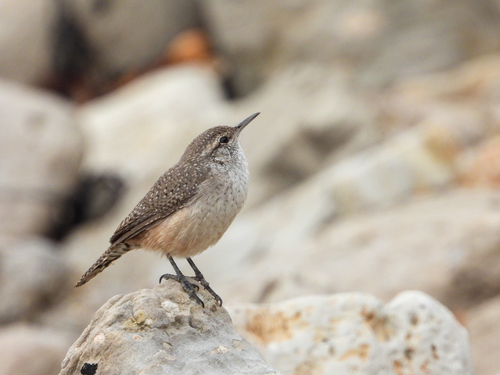
Rock Wren (Salpinctes obsoletus) Rock Wren
Cactus Wren (Campylorhynchus brunneicapillus) Cactus Wren

Media

Loading…

In short

The Rock Wren and Cactus Wren are both desert-dwelling birds, but they can be distinguished by size and plumage patterns. The Cactus Wren is notably larger and has a distinctive spotted breast, while the Rock Wren is smaller with a more uniform grayish-brown appearance.

Identification tips

1. Size: Look for the larger size of the Cactus Wren. 2. Breast Pattern: Check for the Cactus Wren's spotted breast versus the Rock Wren's more uniform plumage. 3. Habitat: Note the presence of cacti for Cactus Wrens and rocky areas for Rock Wrens. 4. Vocalization: Listen for the Cactus Wren's staccato call compared to the Rock Wren's varied song.

Size

The Cactus Wren is larger and bulkier than the Rock Wren, making size a useful field mark when both species are seen together.

Plumage

The Cactus Wren has a boldly spotted breast and a distinctive white supercilium, contrasting with its brown back. The Rock Wren is more uniformly grayish-brown with subtle streaking and lacks the bold spots on the breast.

Behaviour

Cactus Wrens often build large, globular nests and can be seen in pairs or family groups. Rock Wrens are more solitary and are known for their habit of placing pebbles around their nests.

Habitat

Both species inhabit arid regions, but the Cactus Wren is more closely associated with cactus-dominated landscapes, while the Rock Wren prefers rocky outcrops and canyons.

Voice

The Cactus Wren has a distinctive, repetitive, staccato call, while the Rock Wren's song is more varied and melodic, often used for long-distance communication.

Submit a better description

Use the same sections as the comparison. Your text is published immediately.

The Rock Wren and Cactus Wren are both desert-dwelling birds, but they can be distinguished by size and plumage patterns. The Cactus Wren is notably larger and has a distinctive spotted breast, while the Rock Wren is smaller with a more uniform grayish-brown appearance.

1. Size: Look for the larger size of the Cactus Wren. 2. Breast Pattern: Check for the Cactus Wren's spotted breast versus the Rock Wren's more uniform plumage. 3. Habitat: Note the presence of cacti for Cactus Wrens and rocky areas for Rock Wrens. 4. Vocalization: Listen for the Cactus Wren's staccato call compared to the Rock Wren's varied song.

The Cactus Wren is larger and bulkier than the Rock Wren, making size a useful field mark when both species are seen together.

The Cactus Wren has a boldly spotted breast and a distinctive white supercilium, contrasting with its brown back. The Rock Wren is more uniformly grayish-brown with subtle streaking and lacks the bold spots on the breast.

Cactus Wrens often build large, globular nests and can be seen in pairs or family groups. Rock Wrens are more solitary and are known for their habit of placing pebbles around their nests.

Both species inhabit arid regions, but the Cactus Wren is more closely associated with cactus-dominated landscapes, while the Rock Wren prefers rocky outcrops and canyons.

The Cactus Wren has a distinctive, repetitive, staccato call, while the Rock Wren's song is more varied and melodic, often used for long-distance communication.

Discard your changes?

You have unsaved edits. If you leave now, those changes will be lost.

Rock Wren · Cactus Wren · My Tricky Birds