Birdr

Rose-breasted Grosbeak vs Indigo Bunting

Pheucticus ludovicianus versus Passerina cyanea

Play a quiz with Rose-breasted Grosbeak and Indigo Bunting
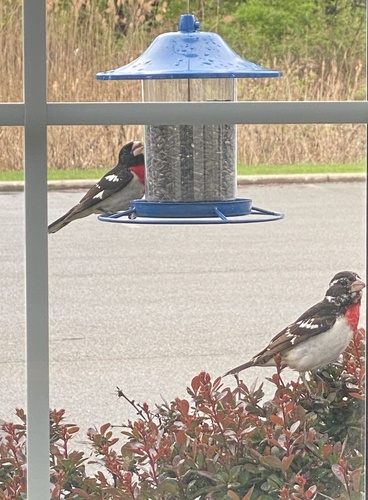
Rose-breasted Grosbeak (Pheucticus ludovicianus) Rose-breasted Grosbeak
Indigo Bunting (Passerina cyanea) Indigo Bunting

Media

Loading…

In short

The Rose-breasted Grosbeak and Indigo Bunting are both members of the Cardinalidae family, but they are easily distinguished by plumage. The male Rose-breasted Grosbeak has a striking black-and-white body with a rose-pink breast, while the male Indigo Bunting is uniformly blue. Females of both species are more similar, being brown, but the Indigo Bunting lacks the streaking found in the female Rose-breasted Grosbeak.

Identification tips

  1. Male plumage: Look for the rose-pink breast of the Rose-breasted Grosbeak versus the all-blue Indigo Bunting. 2. Female plumage: Note the streaked brown of the female Rose-breasted Grosbeak compared to the unstreaked brown of the female Indigo Bunting. 3. Size and shape: The Rose-breasted Grosbeak is larger and more robust. 4. Song: Listen for the sweeter, varied song of the Rose-breasted Grosbeak compared to the high-pitched notes of the Indigo Bunting.

Size

The Rose-breasted Grosbeak is larger and more robust than the smaller, more delicate Indigo Bunting.

Plumage

Male Rose-breasted Grosbeaks have black-and-white plumage with a rose-pink breast, whereas male Indigo Buntings are all blue. Female Rose-breasted Grosbeaks are brown with streaks, while female Indigo Buntings are light brown with buff wing bars and are less streaked.

Behaviour

Both species are known to sing, but the Rose-breasted Grosbeak's song is more similar to the American Robin's, being sweeter and more varied.

Habitat

Rose-breasted Grosbeaks are found in deciduous and mixed forests, often near human habitation, while Indigo Buntings prefer open woodlands and edges.

Voice

The Rose-breasted Grosbeak's song is similar to the American Robin's, sweeter and more varied, while the Indigo Bunting's song is a series of high-pitched notes.

Submit a better description

Use the same sections as the comparison. Your text is published immediately.

The Rose-breasted Grosbeak and Indigo Bunting are both members of the Cardinalidae family, but they are easily distinguished by plumage. The male Rose-breasted Grosbeak has a striking black-and-white body with a rose-pink breast, while the male Indigo Bunting is uniformly blue. Females of both species are more similar, being brown, but the Indigo Bunting lacks the streaking found in the female Rose-breasted Grosbeak.

  1. Male plumage: Look for the rose-pink breast of the Rose-breasted Grosbeak versus the all-blue Indigo Bunting. 2. Female plumage: Note the streaked brown of the female Rose-breasted Grosbeak compared to the unstreaked brown of the female Indigo Bunting. 3. Size and shape: The Rose-breasted Grosbeak is larger and more robust. 4. Song: Listen for the sweeter, varied song of the Rose-breasted Grosbeak compared to the high-pitched notes of the Indigo Bunting.

The Rose-breasted Grosbeak is larger and more robust than the smaller, more delicate Indigo Bunting.

Male Rose-breasted Grosbeaks have black-and-white plumage with a rose-pink breast, whereas male Indigo Buntings are all blue. Female Rose-breasted Grosbeaks are brown with streaks, while female Indigo Buntings are light brown with buff wing bars and are less streaked.

Both species are known to sing, but the Rose-breasted Grosbeak's song is more similar to the American Robin's, being sweeter and more varied.

Rose-breasted Grosbeaks are found in deciduous and mixed forests, often near human habitation, while Indigo Buntings prefer open woodlands and edges.

The Rose-breasted Grosbeak's song is similar to the American Robin's, sweeter and more varied, while the Indigo Bunting's song is a series of high-pitched notes.

Discard your changes?

You have unsaved edits. If you leave now, those changes will be lost.

Rose-breasted Grosbeak · Indigo Bunting · My Tricky Birds