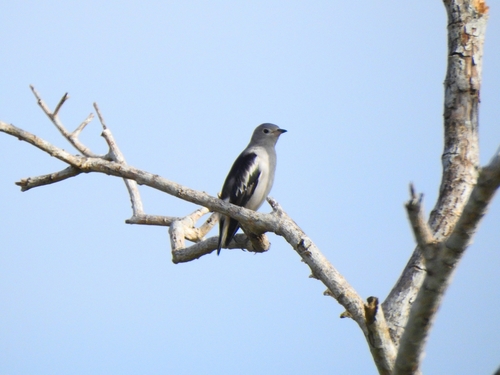
Rose-coloured Starling vs Daurian Starling
Pastor roseus versus Agropsar sturninus
Play a quiz with Rose-coloured Starling and Daurian Starling
Rose-coloured Starling
Daurian Starling
In short
The most reliable way to distinguish a Rose-coloured Starling from a Daurian Starling is by their plumage: the Rose-coloured Starling has a distinctive pale pink body with contrasting black head, wings, and tail, while the Daurian Starling features a more muted coloration with a greyish-brown body and a white face. Both species belong to the starling family and share similar body structures, but their color patterns are key differentiators.
Identification tips
- Plumage: Look for the pale pink body of the Rose-coloured Starling versus the greyish-brown body of the Daurian Starling.
- Head Color: The Rose-coloured Starling has a glossy black head, while the Daurian Starling has a white face.
- Seasonal Changes: Be aware that plumage can vary with season and age, but the Rose-coloured Starling's pink and black contrast is usually distinctive.
- Habitat: Consider the habitat; Rose-coloured Starlings are more likely in open areas, while Daurian Starlings prefer wooded environments.
Size
Both species are similar in size, typical of starlings, with no significant differences in structure such as bill size or tail length.
Plumage
The Rose-coloured Starling has a striking pale pink body with a glossy black head, wings, and tail. In contrast, the Daurian Starling has a greyish-brown body, a white face, and lacks the stark color contrast seen in the Rose-coloured Starling.
Behaviour
Both species exhibit typical starling behavior, such as foraging in flocks and being highly social. There are no significant behavioral differences that aid in field identification.
Habitat
Rose-coloured Starlings are often found in open country, especially near water, while Daurian Starlings prefer wooded areas and are more likely to be seen in forest edges and gardens.
Voice
Both species have similar vocalizations typical of starlings, with varied and complex calls. Specific differences in calls are not well-documented for field identification.