Ross's Goose vs Greater White-fronted Goose
Anser rossii versus Anser albifrons
Play a quiz with Ross's Goose and Greater White-fronted Goose
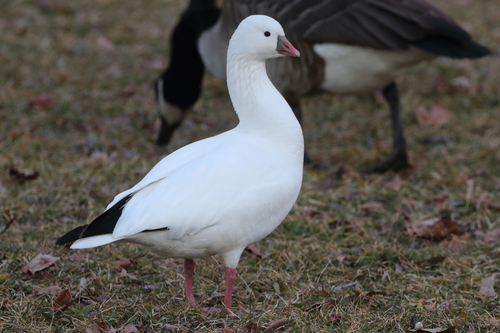
Ross's Goose
Greater White-fronted Goose
In short
Ross's Goose and Greater White-fronted Goose can be distinguished by size and bill structure. Ross's Goose is smaller and has a shorter, more triangular bill compared to the larger, orange-billed Greater White-fronted Goose.
Identification tips
- Size and Bill: Ross's Goose is smaller with a short, triangular bill; Greater White-fronted Goose is larger with an orange bill. 2. Plumage: Look for the white face and black belly bars on the Greater White-fronted Goose. 3. Vocalization: Listen for the higher-pitched calls of Ross's Goose. 4. Association: Ross's Goose often mixes with Snow Geese; Greater White-fronted Goose forms mixed flocks with other geese.
Size
Ross's Goose is significantly smaller than the Greater White-fronted Goose.
Plumage
Ross's Goose is mostly white with black wingtips, while the Greater White-fronted Goose has a grayish-brown body with a distinctive white face patch and black barring on the belly.
Behaviour
Both species are gregarious, but Ross's Goose often associates with Snow Geese, whereas Greater White-fronted Goose forms flocks with other goose species during nonbreeding seasons.
Habitat
Ross's Goose prefers open tundra and wetlands, often seen in agricultural fields during migration. Greater White-fronted Goose has a broader range, including dry tundra, wet tundra, and taiga, and winters in semiarid grasslands and wetlands.
Voice
Ross's Goose has a higher-pitched, more nasal call compared to the deeper honking of the Greater White-fronted Goose.
Ross's Goose · Greater White-fronted Goose · My Tricky Birds