
Rough-legged Buzzard vs Common Buzzard
Buteo lagopus versus Buteo buteo
Play a quiz with Rough-legged Buzzard and Common Buzzard
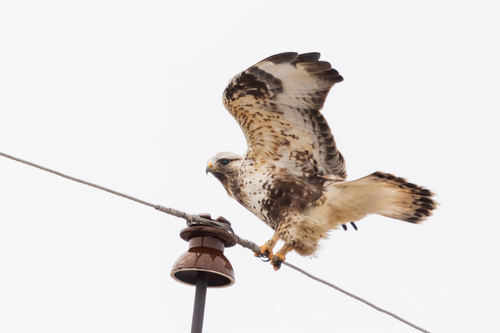 Rough-legged Buzzard
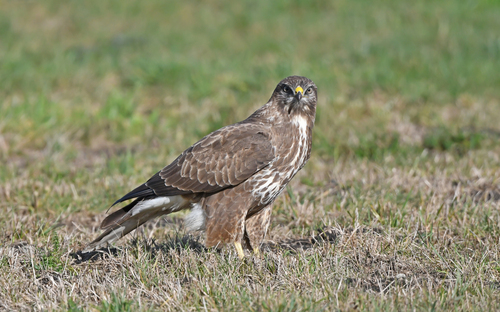 Common Buzzard
In short
The most reliable field mark to separate Rough-legged Buzzard from Common Buzzard is the presence of a bold, dark carpal ('wrist') patch on the underwing in all plumages of Rough-legged, especially striking in light-morph birds, along with a white tail base and one or more dark subterminal tail bands. Juvenile and adult Rough-leggeds also show longer wings and a more eagle-like, elongated silhouette in flight, with wing tips that often reach or extend past the tail when perched. Common Buzzard lacks the dark carpal patch and white tail base, usually showing more uniform barring on wings and tail, and appears shorter-winged and chunkier overall. Both species are variable in plumage, but structure and underwing pattern are the most dependable differences, especially for birds in flight.
Identification tips
- Dark carpal ('wrist') patch on underwing (all ages, especially light morphs): Rough-legged Buzzard always shows a bold, square dark patch at the carpal joint, contrasting with pale underwing coverts. Common Buzzard never shows a true carpal patch—if present, any darkness is diffuse and not sharply defined.
- White tail base with bold dark subterminal band(s) (all ages): Rough-leggeds show a mostly white tail with one or more dark bands near the tip. Common Buzzard's tail is barred throughout, lacking a clean white base or bold terminal band.
- Longer wings and tail, more eagle-like silhouette (all ages): In flight, Rough-leggeds have longer, narrower wings and a longer tail, giving a stretched, elegant look. Common Buzzard appears shorter-winged, broader, and chunkier.
- Wing tips reach or extend past tail when perched (all ages): On a perched Rough-legged, the primaries often reach or slightly exceed the tail tip. In Common Buzzard, the primaries fall short of the tail.
- Feathered tarsi ('fluffy legs') (all ages): Rough-legged Buzzard has feathering all the way down the legs, giving a 'fluffy' look. Common Buzzard's lower legs are bare and yellow. This is best seen on perched birds at close range.
- Broad dark chest band (most plumages): Rough-leggeds often show a contrasting dark band across the chest, separating pale underparts from darker upperparts. Common Buzzard may have a chest band but it is usually less defined or absent.
- Plumage variability and pitfalls: Both species are highly variable, but Common Buzzard is especially so, ranging from very pale to very dark. Dark morph Rough-leggeds can resemble dark Common Buzzards, but still show the carpal patch and white tail base. Always check for these features.
- Behavior—hovering: Rough-legged Buzzard frequently hovers while hunting, a behavior rare in Common Buzzard. If you see a large Buteo hovering for extended periods, Rough-legged is much more likely.
- Flight style: Rough-leggeds are more buoyant and often hold their wings in a shallow V (dihedral). Common Buzzard soars on flatter, broader wings and appears heavier in flight.
- Habitat context: In winter, Rough-leggeds are found in open, often treeless landscapes. If you see a Buteo in dense woodland or near settlements, Common Buzzard is more likely.
- Bill and talon size: Rough-leggeds have relatively small bills and talons for their size, reflecting their diet of small mammals. This is subtle but can be noticed at close range.
- Seasonal context: Rough-leggeds are only present in temperate Europe and Asia during winter; Common Buzzard is present year-round.
- Overlap and confusion: In areas where both species winter, always check underwing pattern and tail before relying on overall color or size.
- Sex and age: Females of both species are larger, but this is not a reliable field mark. Juvenile and adult Rough-leggeds retain the key carpal patch and tail pattern.
- When in doubt: Focus on the underwing carpal patch and tail pattern in flight, and leg feathering and wing projection when perched. These are the most consistent differences.
Size
Rough-legged Buzzard averages slightly heavier (925.8 g vs 878.25 g) and is longer-winged and longer-tailed than Common Buzzard, though the difference is subtle and not always obvious in the field. Rough-leggeds have a more elongated, eagle-like profile, while Common Buzzards are stockier and broader-bodied. Females of both species are larger than males, but this is not a reliable field mark unless birds are side by side.
Plumage
- Juveniles and immatures (most likely to be confused): Rough-legged Buzzard of all ages, especially light morphs, show a distinctive dark carpal patch on the underwing, contrasting with otherwise pale underwing coverts, and a white tail with one or more bold dark subterminal bands. Common Buzzard never shows a true dark carpal patch; instead, the underwing is more evenly barred or mottled, and the tail is barred throughout without a clean white base or bold subterminal band.
- Adults: Rough-leggeds retain the carpal patch and white tail base with dark band(s), while Common Buzzards remain variable but lack these features. Both species can be very variable in overall darkness, but Rough-leggeds tend to have more contrast between the pale underparts and dark chest band, while Common Buzzards are often more uniformly brown or show less contrast.
- Perched birds: Rough-leggeds have feathered tarsi (legs), giving a 'fluffy-legged' look, while Common Buzzard's legs are bare and yellow. The wing tips of Rough-leggeds often reach or extend beyond the tail when perched; in Common Buzzard, the wing tips fall short of the tail.
Behaviour
Rough-legged Buzzard is unique among large Buteos in regularly hovering while hunting, often holding position with rapid wingbeats over open ground. Common Buzzard rarely hovers, instead soaring or gliding with slow, deep wingbeats, or perching for long periods. In flight, Rough-leggeds often appear more buoyant and eagle-like, with longer, narrower wings and a tendency to hold the wings in a slight dihedral (V-shape). Common Buzzards are more likely to be seen soaring on broad, rounded wings, with a stockier profile and less pronounced dihedral.
Habitat
Rough-legged Buzzard breeds in arctic and subarctic tundra and is only present in temperate regions during winter, often in open country such as marshes, moorland, and farmland. Common Buzzard is resident or short-distance migrant across much of Europe and western Asia, found in a wide range of habitats including woodland edges, farmland, and even near human settlements. In winter, both species can overlap in open country, but Rough-leggeds are more tied to treeless or sparsely treed landscapes.