Birdr

Rough-legged Buzzard vs Long-legged Buzzard

Buteo lagopus versus Buteo rufinus

Play a quiz with Rough-legged Buzzard and Long-legged Buzzard
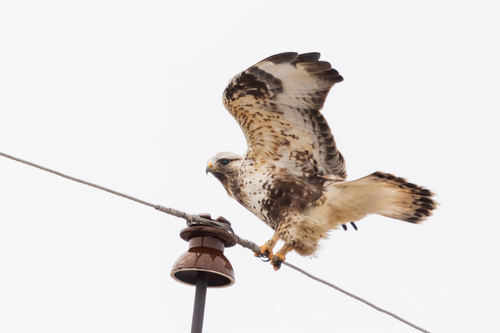
Rough-legged Buzzard (Buteo lagopus) Rough-legged Buzzard
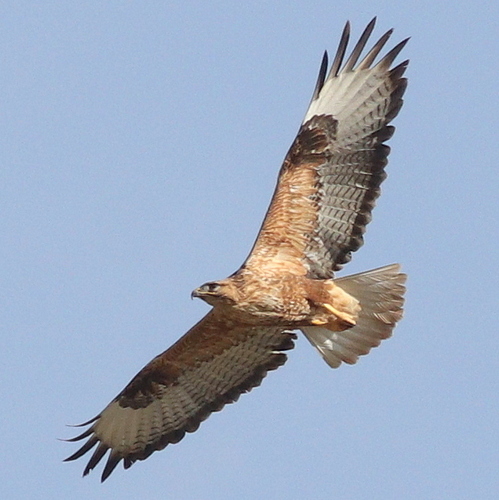
Long-legged Buzzard (Buteo rufinus) Long-legged Buzzard

Media

Loading…

In short

The Rough-legged Buzzard and Long-legged Buzzard can be distinguished by their structure and plumage patterns. The Rough-legged Buzzard has feathered legs and a distinctive dark belly patch, while the Long-legged Buzzard lacks feathered legs and has a more uniform underbody. Both species inhabit open areas, but their ranges do not typically overlap.

Identification tips

  1. Look for feathered legs on the Rough-legged Buzzard. 2. Check for a dark belly patch on the Rough-legged Buzzard. 3. Observe the tail: Rough-legged has a pale tail with a dark band, while Long-legged may have a rufous tail. 4. Consider the habitat: Rough-legged in colder, open areas; Long-legged in warmer, arid regions. 5. Note behavior: Rough-legged more prone to hovering.

Size

Both species are similar in size, with the Long-legged Buzzard being slightly larger and more robust.

Plumage

The Rough-legged Buzzard often shows a dark belly patch and feathered legs, which are key features. It also has a pale head and tail with a dark terminal band. The Long-legged Buzzard lacks feathered legs and typically has a more uniform underbody coloration, with a rufous or reddish tail in some morphs.

Behaviour

Both species hunt in open areas, often seen hovering or soaring. The Rough-legged Buzzard is more likely to hover in place, a behavior less common in the Long-legged Buzzard.

Habitat

Rough-legged Buzzards breed in tundra and taiga regions and winter in open country. Long-legged Buzzards prefer open, arid regions such as steppes and semi-deserts, often at lower elevations.

Voice

Vocalizations are not well-documented for field identification, but both species are generally quiet.

Submit a better description

Use the same sections as the comparison. Your text is published immediately.

The Rough-legged Buzzard and Long-legged Buzzard can be distinguished by their structure and plumage patterns. The Rough-legged Buzzard has feathered legs and a distinctive dark belly patch, while the Long-legged Buzzard lacks feathered legs and has a more uniform underbody. Both species inhabit open areas, but their ranges do not typically overlap.

  1. Look for feathered legs on the Rough-legged Buzzard. 2. Check for a dark belly patch on the Rough-legged Buzzard. 3. Observe the tail: Rough-legged has a pale tail with a dark band, while Long-legged may have a rufous tail. 4. Consider the habitat: Rough-legged in colder, open areas; Long-legged in warmer, arid regions. 5. Note behavior: Rough-legged more prone to hovering.

Both species are similar in size, with the Long-legged Buzzard being slightly larger and more robust.

The Rough-legged Buzzard often shows a dark belly patch and feathered legs, which are key features. It also has a pale head and tail with a dark terminal band. The Long-legged Buzzard lacks feathered legs and typically has a more uniform underbody coloration, with a rufous or reddish tail in some morphs.

Both species hunt in open areas, often seen hovering or soaring. The Rough-legged Buzzard is more likely to hover in place, a behavior less common in the Long-legged Buzzard.

Rough-legged Buzzards breed in tundra and taiga regions and winter in open country. Long-legged Buzzards prefer open, arid regions such as steppes and semi-deserts, often at lower elevations.

Vocalizations are not well-documented for field identification, but both species are generally quiet.

Discard your changes?

You have unsaved edits. If you leave now, those changes will be lost.

Rough-legged Buzzard · Long-legged Buzzard · My Tricky Birds