Birdr

Ruddy-breasted Seedeater vs Chestnut-bellied Seed-Finch

Sporophila minuta versus Sporophila angolensis

Play a quiz with Ruddy-breasted Seedeater and Chestnut-bellied Seed-Finch
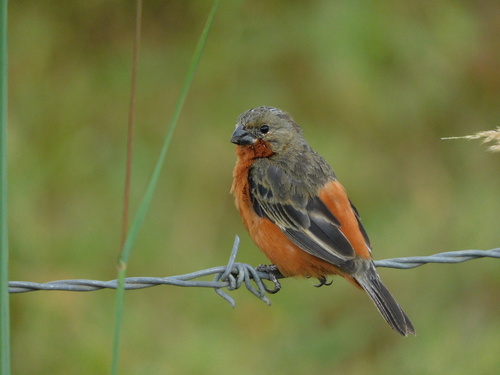
Ruddy-breasted Seedeater (Sporophila minuta) Ruddy-breasted Seedeater
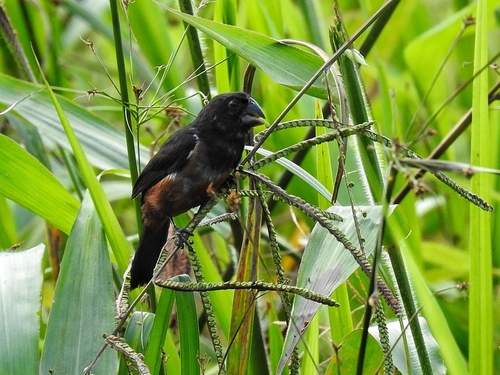
Chestnut-bellied Seed-Finch (Sporophila angolensis) Chestnut-bellied Seed-Finch

Media

Loading…

In short

The Ruddy-breasted Seedeater and the Chestnut-bellied Seed-Finch can be distinguished by their size and bill structure. The Chestnut-bellied Seed-Finch is larger with a noticeably thicker bill, while the Ruddy-breasted Seedeater is smaller and more delicate in appearance. Both species share similar habitats but differ in vocalizations.

Identification tips

1. Look for the larger size and thicker bill of the Chestnut-bellied Seed-Finch. 2. Note the more uniform ruddy coloration of the Ruddy-breasted Seedeater compared to the contrasting black and chestnut of the Chestnut-bellied Seed-Finch. 3. Listen for the louder song of the Chestnut-bellied Seed-Finch. 4. Consider the habitat; both species can be found in similar areas, so rely more on physical and vocal differences.

Size

The Chestnut-bellied Seed-Finch is larger than the Ruddy-breasted Seedeater.

Plumage

The Ruddy-breasted Seedeater has a more uniform ruddy or chestnut coloration on its breast, while the Chestnut-bellied Seed-Finch has a darker, more pronounced chestnut belly with contrasting black upperparts.

Behaviour

Both species may forage in flocks outside the breeding season, but specific behavioral differences are not well-documented.

Habitat

Both species inhabit similar environments, often found in grasslands and open areas with scattered trees.

Voice

The Chestnut-bellied Seed-Finch has a distinctive, loud song, while the Ruddy-breasted Seedeater's vocalizations are less documented but generally softer.

Submit a better description

Use the same sections as the comparison. Your text is published immediately.

The Ruddy-breasted Seedeater and the Chestnut-bellied Seed-Finch can be distinguished by their size and bill structure. The Chestnut-bellied Seed-Finch is larger with a noticeably thicker bill, while the Ruddy-breasted Seedeater is smaller and more delicate in appearance. Both species share similar habitats but differ in vocalizations.

1. Look for the larger size and thicker bill of the Chestnut-bellied Seed-Finch. 2. Note the more uniform ruddy coloration of the Ruddy-breasted Seedeater compared to the contrasting black and chestnut of the Chestnut-bellied Seed-Finch. 3. Listen for the louder song of the Chestnut-bellied Seed-Finch. 4. Consider the habitat; both species can be found in similar areas, so rely more on physical and vocal differences.

The Chestnut-bellied Seed-Finch is larger than the Ruddy-breasted Seedeater.

The Ruddy-breasted Seedeater has a more uniform ruddy or chestnut coloration on its breast, while the Chestnut-bellied Seed-Finch has a darker, more pronounced chestnut belly with contrasting black upperparts.

Both species may forage in flocks outside the breeding season, but specific behavioral differences are not well-documented.

Both species inhabit similar environments, often found in grasslands and open areas with scattered trees.

The Chestnut-bellied Seed-Finch has a distinctive, loud song, while the Ruddy-breasted Seedeater's vocalizations are less documented but generally softer.

Discard your changes?

You have unsaved edits. If you leave now, those changes will be lost.

Ruddy-breasted Seedeater · Chestnut-bellied Seed-Finch · My Tricky Birds