Birdr

Ruddy-capped Nightingale-Thrush vs Grey-cheeked Thrush

Catharus frantzii versus Catharus minimus

Play a quiz with Ruddy-capped Nightingale-Thrush and Grey-cheeked Thrush
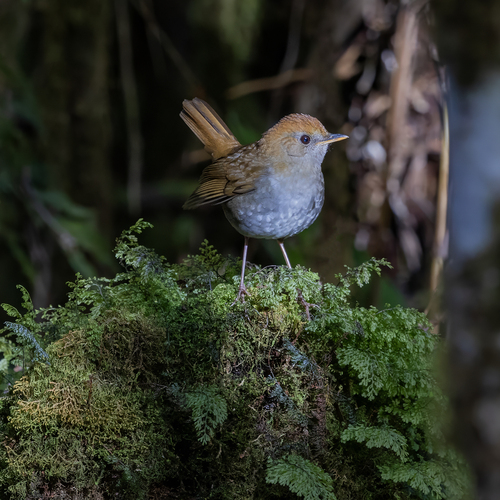
Ruddy-capped Nightingale-Thrush (Catharus frantzii) Ruddy-capped Nightingale-Thrush
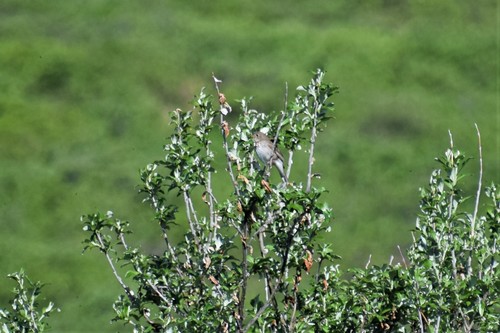
Grey-cheeked Thrush (Catharus minimus) Grey-cheeked Thrush

Media

Loading…

In short

The Ruddy-capped Nightingale-Thrush and Grey-cheeked Thrush can be distinguished by their distinct plumage and habitat preferences. The Ruddy-capped has a rufous crown and is found in high-elevation forests, while the Grey-cheeked is more uniformly brown and occupies dense undergrowth in coniferous forests during breeding.

Identification tips

Size

Both species are similar in size, typical of small thrushes.

Plumage

The Ruddy-capped Nightingale-Thrush has a distinctive rufous crown and gray-white underparts, whereas the Grey-cheeked Thrush is more uniformly brown with no rufous crown, and has a paler, less contrasting face.

Behaviour

Both species are often elusive and may be more easily detected by their calls. The Ruddy-capped is more likely to be seen feeding in the open during early morning or late afternoon.

Habitat

The Ruddy-capped Nightingale-Thrush inhabits high-elevation forests (1500–3500 m), while the Grey-cheeked Thrush prefers dense undergrowth in coniferous forests and thickets during breeding.

Voice

Vocalizations differ, but specifics are not well-documented here. Playback can be useful for locating the Ruddy-capped.

Submit a better description

Use the same sections as the comparison. Your text is published immediately.

The Ruddy-capped Nightingale-Thrush and Grey-cheeked Thrush can be distinguished by their distinct plumage and habitat preferences. The Ruddy-capped has a rufous crown and is found in high-elevation forests, while the Grey-cheeked is more uniformly brown and occupies dense undergrowth in coniferous forests during breeding.

  • Look for the rufous crown on the Ruddy-capped Nightingale-Thrush.
  • Observe habitat: high-elevation forests suggest Ruddy-capped, while dense coniferous undergrowth suggests Grey-cheeked.
  • Use call playback to help identify the Ruddy-capped Nightingale-Thrush.

Both species are similar in size, typical of small thrushes.

The Ruddy-capped Nightingale-Thrush has a distinctive rufous crown and gray-white underparts, whereas the Grey-cheeked Thrush is more uniformly brown with no rufous crown, and has a paler, less contrasting face.

Both species are often elusive and may be more easily detected by their calls. The Ruddy-capped is more likely to be seen feeding in the open during early morning or late afternoon.

The Ruddy-capped Nightingale-Thrush inhabits high-elevation forests (1500–3500 m), while the Grey-cheeked Thrush prefers dense undergrowth in coniferous forests and thickets during breeding.

Vocalizations differ, but specifics are not well-documented here. Playback can be useful for locating the Ruddy-capped.

Discard your changes?

You have unsaved edits. If you leave now, those changes will be lost.

Ruddy-capped Nightingale-Thrush · Grey-cheeked Thrush · My Tricky Birds