Birdr

Ruddy Kingfisher vs White-throated Kingfisher

Halcyon coromanda versus Halcyon smyrnensis

Play a quiz with Ruddy Kingfisher and White-throated Kingfisher
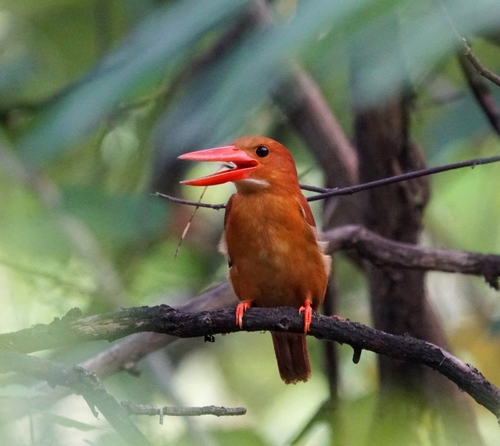
Ruddy Kingfisher (Halcyon coromanda) Ruddy Kingfisher
White-throated Kingfisher (Halcyon smyrnensis) White-throated Kingfisher

Media

Loading…

In short

The Ruddy Kingfisher and White-throated Kingfisher are both medium-sized kingfishers with distinct plumage differences. The Ruddy Kingfisher is primarily rufous with a lack of contrasting throat color, while the White-throated Kingfisher has a striking white throat and breast. Both species are found in overlapping habitats, but their vocalizations and behavior can aid in identification.

Identification tips

  1. Look for the white throat and breast of the White-throated Kingfisher. 2. Note the uniform rufous color of the Ruddy Kingfisher. 3. Listen for the loud, varied calls of the White-throated Kingfisher compared to the slow whistles of the Ruddy Kingfisher. 4. Consider habitat: White-throated Kingfishers are more common in open and urban areas.

Size

Both species are similar in size, with the White-throated Kingfisher being slightly larger on average.

Plumage

The Ruddy Kingfisher is uniformly rufous with no contrasting throat patch, whereas the White-throated Kingfisher has a vivid white throat and breast, contrasting with its chestnut belly and bright blue wings and back.

Behaviour

Both species are often seen perched quietly, but the White-throated Kingfisher is more likely to be observed in open areas and is known for its conspicuous behavior.

Habitat

Both species inhabit a variety of wooded and semi-open areas, but the White-throated Kingfisher is more adaptable to urban and agricultural landscapes.

Voice

The Ruddy Kingfisher has a series of slow, mournful whistles, while the White-throated Kingfisher produces loud, raucous calls that are more varied and frequent.

Submit a better description

Use the same sections as the comparison. Your text is published immediately.

The Ruddy Kingfisher and White-throated Kingfisher are both medium-sized kingfishers with distinct plumage differences. The Ruddy Kingfisher is primarily rufous with a lack of contrasting throat color, while the White-throated Kingfisher has a striking white throat and breast. Both species are found in overlapping habitats, but their vocalizations and behavior can aid in identification.

  1. Look for the white throat and breast of the White-throated Kingfisher. 2. Note the uniform rufous color of the Ruddy Kingfisher. 3. Listen for the loud, varied calls of the White-throated Kingfisher compared to the slow whistles of the Ruddy Kingfisher. 4. Consider habitat: White-throated Kingfishers are more common in open and urban areas.

Both species are similar in size, with the White-throated Kingfisher being slightly larger on average.

The Ruddy Kingfisher is uniformly rufous with no contrasting throat patch, whereas the White-throated Kingfisher has a vivid white throat and breast, contrasting with its chestnut belly and bright blue wings and back.

Both species are often seen perched quietly, but the White-throated Kingfisher is more likely to be observed in open areas and is known for its conspicuous behavior.

Both species inhabit a variety of wooded and semi-open areas, but the White-throated Kingfisher is more adaptable to urban and agricultural landscapes.

The Ruddy Kingfisher has a series of slow, mournful whistles, while the White-throated Kingfisher produces loud, raucous calls that are more varied and frequent.

Discard your changes?

You have unsaved edits. If you leave now, those changes will be lost.

Ruddy Kingfisher · White-throated Kingfisher · My Tricky Birds