
Ruddy Shelduck vs Northern Shoveler
Tadorna ferruginea versus Spatula clypeata
Play a quiz with Ruddy Shelduck and Northern Shoveler
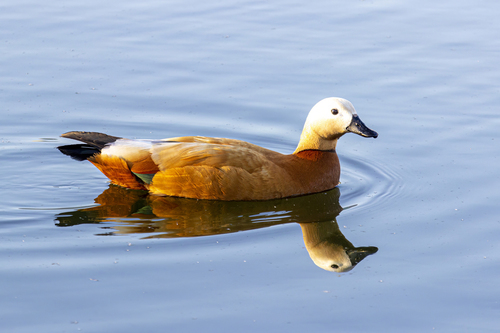 Ruddy Shelduck
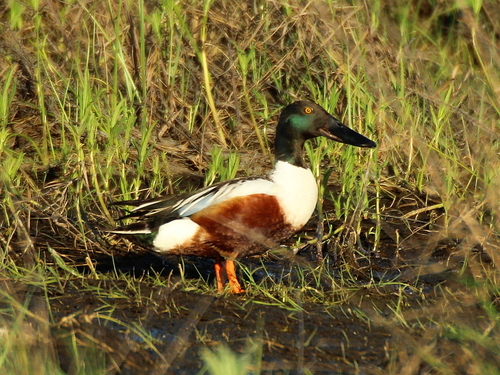 Northern Shoveler
In short
The most reliable field mark to separate Ruddy Shelduck from Northern Shoveler in any plumage is the combination of overall structure and wing pattern in flight: Ruddy Shelduck shows striking white upperwing coverts contrasting with black flight feathers, while Northern Shoveler has a pale blue forewing (on both sexes, most obvious in flight) and a green speculum separated by a white border. Ruddy Shelduck is a large, orange-brown, goose-like duck with a pale head and dark tail, whereas Northern Shoveler is smaller, with a long, broad, spatulate bill and a more typical duck shape. Juvenile and female shovelers are mottled brown but always show the distinctive bill and pale blue forewing. Both species can occur on large water bodies, but the shelduck is bulkier and more upright, while the shoveler is more likely to be seen dabbling with its bill sweeping side to side.
Identification tips
- In flight, look for the upperwing pattern: Ruddy Shelduck of all ages and sexes shows a large white panel (upperwing coverts) contrasting with black flight feathers and tail; this is bold and obvious from below or above. Northern Shoveler (all ages/sexes) shows a pale blue forewing and green speculum bordered by white, never a solid white panel.
- Bill shape is a failsafe: Shoveler has a long, broad, spatulate bill (grey to black in males, grey with orange tinges in females/juveniles), unique among ducks and never matched by the shelduck. Ruddy Shelduck has a normal, black duck bill.
- Overall structure: Ruddy Shelduck is large, upright, and goose-like, with a long neck and legs, while shoveler is compact, low-slung, and more typical of dabbling ducks.
- Body color: Ruddy Shelduck is orange-brown with a paler (male: orange-brown, female: whitish) head and black tail; shoveler males (breeding) have a green head, white breast, chestnut flanks, and black bill, while females/juveniles are mottled brown.
- Head and neck: Shelduck males may show a narrow black collar (breeding), absent in eclipse/female/juvenile; shovelers never show a collar or pale head.
- Tail and rump: Ruddy Shelduck always has a black tail and rump, contrasting with the body; shoveler's tail is not contrasting.
- Leg color: Shoveler legs are bright orange-red; shelduck legs are dark grey, but this is rarely visible at distance.
- Perched/at rest: Shelduck's white wing panel is mostly hidden when perched, so rely on body color and structure; shoveler's blue forewing is also mostly hidden, but bill shape and body pattern remain clear.
- Juvenile confusion: Juvenile/female shovelers are mottled brown but always show the spatulate bill and pale blue forewing in flight; juvenile shelducks are darker brown but still have the pale head and white wing panel.
- Feeding behavior: Shovelers often sweep their bill side to side at the water's surface; shelducks graze or swim without this motion.
- Vocalizations: Loud, nasal honking suggests shelduck; shovelers are quieter and less vocal.
- Size in mixed flocks: Shelduck dwarfs shovelers; if both are present, the size gap is obvious.
- Habitat context: Shelduck may be found away from water or in open, less vegetated areas; shoveler sticks to marshes and water edges.
- Seasonal changes: Shelduck males lose the black collar outside breeding; shoveler males lose much of their bold color in eclipse but retain the blue forewing and spatulate bill.
- When in doubt, trust the bill and wing pattern: These are the most consistently reliable marks across all ages and seasons.
Size
Ruddy Shelduck is substantially larger and heavier, with a length of 58–70 cm and a body mass around 1230 g [wikidata], compared to Northern Shoveler's 44–52 cm length and 500–800 g typical mass [wikipedia]. The shelduck has a much broader wingspan (110–135 cm vs. 70–84 cm) and a bulkier, more goose-like build. In the field, the shelduck stands taller and appears more upright, while the shoveler is compact and sits lower on the water.
Plumage
In all ages and sexes, Ruddy Shelduck in flight shows a bold contrast between white upperwing coverts and black flight feathers and tail; this white is visible as a large panel on the upperwing, especially in flight, but is mostly hidden when perched. Juveniles are similar to females but darker brown, still with the white wing coverts in flight. Males in breeding plumage have a narrow black collar, lost in eclipse and juvenile plumages. Females and juveniles have a pale, whitish head and neck, lacking the collar. Northern Shoveler males in breeding plumage have an iridescent green head, white breast, and chestnut flanks, with a black bill; in eclipse (late summer/fall), males resemble females but retain the pale blue forewing. Females and juveniles are mottled brown overall, with a long, broad, spatulate bill and a greyish forewing in flight, plus a green speculum bordered by white. The pale blue forewing (visible in both sexes and ages) is diagnostic for shoveler and never shown by shelduck. On the ground, the shelduck's orange-brown body and pale head contrast with the shoveler's more cryptic, streaked brown (female/juvenile) or bold, patterned (male) plumage.
Behaviour
Ruddy Shelduck is often seen standing upright on land or swimming high on the water, sometimes far from the water's edge, and may be found in pairs or small groups. Northern Shoveler is more likely to be seen dabbling at the water's surface, often swinging its bill side to side to filter food, and usually remains in the water or at the water's edge. Shovelers are less gregarious than some ducks but can form small flocks. The shelduck's behavior is more reminiscent of a small goose, while the shoveler is a classic dabbling duck.
Habitat
Both species can be found on large lakes, reservoirs, and rivers, but Ruddy Shelduck is more likely to be seen on open inland water bodies, sometimes at higher elevations or away from water during breeding. Northern Shoveler prefers mud-bottomed marshes rich in invertebrates and is more strictly aquatic, rarely straying far from water. In overlapping wintering areas (e.g., Indian subcontinent), context may not help, but the shelduck is often in more open, less vegetated habitats.
Voice
Ruddy Shelduck gives loud, nasal honking calls, often heard both on the ground and in flight, with male and female calls differing subtly. Northern Shoveler is generally quieter, with no mention of distinctive calls in the provided notes; their vocalizations are less likely to be heard or diagnostic in the field.