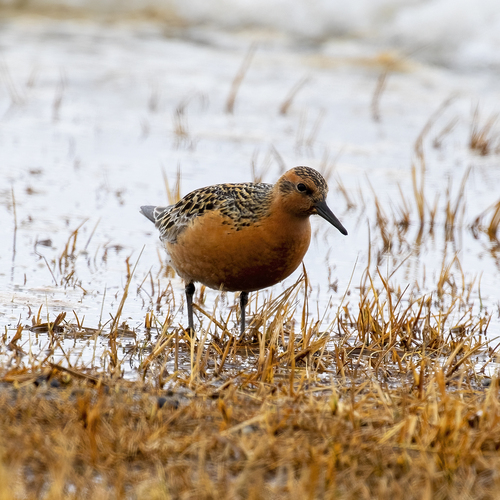
Ruddy Turnstone vs Red Knot
Arenaria interpres versus Calidris canutus
Play a quiz with Ruddy Turnstone and Red Knot
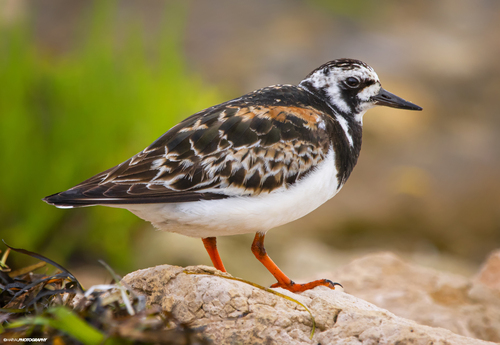
Ruddy Turnstone
Red Knot
In short
The Ruddy Turnstone and Red Knot are both medium-sized shorebirds, but they can be distinguished by their plumage and behavior. The Ruddy Turnstone has a striking black and white pattern with orange legs, while the Red Knot is more uniform with a grayish tone in non-breeding plumage. Behaviorally, Turnstones are often seen flipping over stones and debris, a behavior not observed in Red Knots.
Identification tips
- Look for the bold black and white pattern and orange legs of the Ruddy Turnstone. 2. Observe behavior: Turnstones flip stones, while Knots probe mudflats. 3. In non-breeding plumage, Red Knots are more uniformly gray and lack the Turnstone's striking patterns. 4. Consider habitat: Turnstones prefer rocky shores, while Knots are often on mudflats.
Size
Both species are similar in size, but the Red Knot is slightly larger and more robust.
Plumage
The Ruddy Turnstone has a distinctive black and white pattern on its head and chest, with bright orange legs. In contrast, the Red Knot in non-breeding plumage is more uniform gray above and white below, lacking the bold patterns of the Turnstone.
Behaviour
Ruddy Turnstones are known for their unique behavior of flipping over stones and debris to find food. Red Knots do not exhibit this behavior and are more likely to be seen probing mudflats for invertebrates.
Habitat
Both species are found in coastal habitats, but the Red Knot is more likely to be seen in large flocks on mudflats and sandy beaches during migration, while the Ruddy Turnstone is often found on rocky shores.
Voice
Vocalizations are not a primary distinguishing feature between these species in the field.