Birdr

Ruff vs Sharp-tailed Sandpiper

Calidris pugnax versus Calidris acuminata

Play a quiz with Ruff and Sharp-tailed Sandpiper
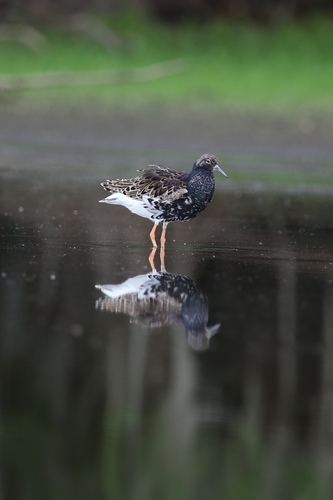
Ruff (Calidris pugnax) Ruff
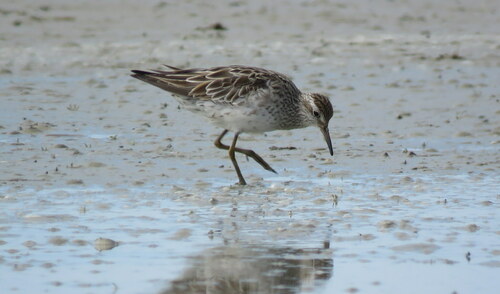
Sharp-tailed Sandpiper (Calidris acuminata) Sharp-tailed Sandpiper

Media

Loading…

In short

The Ruff and Sharp-tailed Sandpiper are both medium-sized shorebirds, but they can be distinguished by their structure and plumage. The Ruff is larger with a bulkier build and a distinctive breeding plumage in males, while the Sharp-tailed Sandpiper is more compact with a more defined supercilium.

Identification tips

  1. Size and Structure: Look for the Ruff's larger size and bulkier build. 2. Plumage: In breeding season, male Ruffs have distinctive ruffs and collars. Sharp-tailed Sandpipers have a more defined supercilium and rufous crown. 3. Behavior: Observe for lekking behavior in Ruffs during breeding season. 4. Habitat: Consider the habitat; Ruffs are more likely in wetland areas, while Sharp-tailed Sandpipers are often in tundra or coastal areas during migration.

Size

The Ruff is larger and bulkier compared to the more compact Sharp-tailed Sandpiper.

Plumage

Ruffs exhibit a wide variety of plumage, especially in males during breeding season, with elaborate ruffs and collars. Sharp-tailed Sandpipers have a more uniform plumage with a distinct supercilium and a rufous crown.

Behaviour

Ruffs are known for their lekking behavior during breeding, where males display in groups. Sharp-tailed Sandpipers do not lek and are more solitary or found in small groups.

Habitat

Ruffs are often found in wetlands, marshes, and flooded fields, while Sharp-tailed Sandpipers prefer tundra and grassy wetlands during breeding and migrate to coastal mudflats and marshes.

Voice

Vocalizations are not a primary distinguishing feature between these species in the field.

Submit a better description

Use the same sections as the comparison. Your text is published immediately.

The Ruff and Sharp-tailed Sandpiper are both medium-sized shorebirds, but they can be distinguished by their structure and plumage. The Ruff is larger with a bulkier build and a distinctive breeding plumage in males, while the Sharp-tailed Sandpiper is more compact with a more defined supercilium.

  1. Size and Structure: Look for the Ruff's larger size and bulkier build. 2. Plumage: In breeding season, male Ruffs have distinctive ruffs and collars. Sharp-tailed Sandpipers have a more defined supercilium and rufous crown. 3. Behavior: Observe for lekking behavior in Ruffs during breeding season. 4. Habitat: Consider the habitat; Ruffs are more likely in wetland areas, while Sharp-tailed Sandpipers are often in tundra or coastal areas during migration.

The Ruff is larger and bulkier compared to the more compact Sharp-tailed Sandpiper.

Ruffs exhibit a wide variety of plumage, especially in males during breeding season, with elaborate ruffs and collars. Sharp-tailed Sandpipers have a more uniform plumage with a distinct supercilium and a rufous crown.

Ruffs are known for their lekking behavior during breeding, where males display in groups. Sharp-tailed Sandpipers do not lek and are more solitary or found in small groups.

Ruffs are often found in wetlands, marshes, and flooded fields, while Sharp-tailed Sandpipers prefer tundra and grassy wetlands during breeding and migrate to coastal mudflats and marshes.

Vocalizations are not a primary distinguishing feature between these species in the field.

Discard your changes?

You have unsaved edits. If you leave now, those changes will be lost.

Ruff · Sharp-tailed Sandpiper · My Tricky Birds