Birdr

Rufous-breasted Hermit vs Band-tailed Barbthroat

Glaucis hirsutus versus Threnetes ruckeri

Play a quiz with Rufous-breasted Hermit and Band-tailed Barbthroat
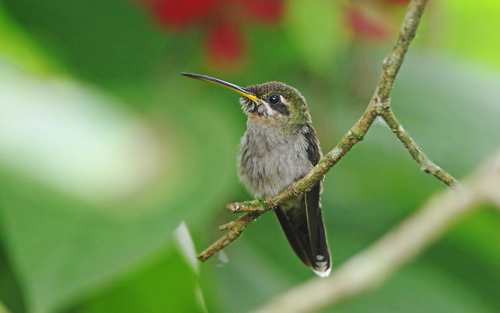
Rufous-breasted Hermit (Glaucis hirsutus) Rufous-breasted Hermit
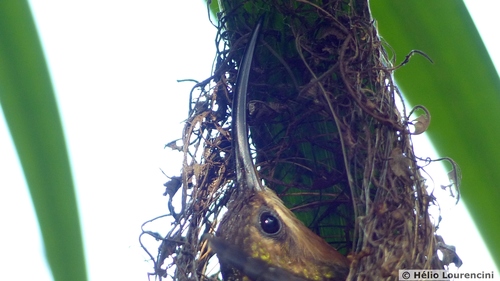
Band-tailed Barbthroat (Threnetes ruckeri) Band-tailed Barbthroat

Media

Loading…

In short

The Rufous-breasted Hermit and Band-tailed Barbthroat are two similar hummingbirds often confused due to their overlapping ranges and similar size. The most reliable field mark is the tail: the Rufous-breasted Hermit has a more distinctly rufous tail with a dark band, while the Band-tailed Barbthroat's tail is more uniformly colored with a subtle band. Both species have long decurved bills, but the Rufous-breasted Hermit's bill is slightly longer and more curved.

Identification tips

Check the tail first: Rufous-breasted Hermit has a rufous tail with a dark band, while Band-tailed Barbthroat's tail is more uniformly colored. Observe the bill: Rufous-breasted Hermit's bill is longer and more curved. Consider habitat and behavior: Both are found in similar environments, so focus on structural differences. Vocalizations are not a reliable differentiator.

Size

Both species are similar in size, typical of medium-sized hermits.

Plumage

The Rufous-breasted Hermit has a rufous breast and belly with a contrasting dark band on the tail. The Band-tailed Barbthroat has a more uniformly colored tail with a less pronounced band and a paler overall appearance.

Behaviour

Both species exhibit typical hermit behavior, often seen hovering near flowers and feeding on nectar.

Habitat

Both species inhabit similar tropical forest environments, often found in understory and edge habitats.

Voice

Vocalizations are not well-documented for field differentiation, but both species have typical hummingbird calls.

Submit a better description

Use the same sections as the comparison. Your text is published immediately.

The Rufous-breasted Hermit and Band-tailed Barbthroat are two similar hummingbirds often confused due to their overlapping ranges and similar size. The most reliable field mark is the tail: the Rufous-breasted Hermit has a more distinctly rufous tail with a dark band, while the Band-tailed Barbthroat's tail is more uniformly colored with a subtle band. Both species have long decurved bills, but the Rufous-breasted Hermit's bill is slightly longer and more curved.

Check the tail first: Rufous-breasted Hermit has a rufous tail with a dark band, while Band-tailed Barbthroat's tail is more uniformly colored. Observe the bill: Rufous-breasted Hermit's bill is longer and more curved. Consider habitat and behavior: Both are found in similar environments, so focus on structural differences. Vocalizations are not a reliable differentiator.

Both species are similar in size, typical of medium-sized hermits.

The Rufous-breasted Hermit has a rufous breast and belly with a contrasting dark band on the tail. The Band-tailed Barbthroat has a more uniformly colored tail with a less pronounced band and a paler overall appearance.

Both species exhibit typical hermit behavior, often seen hovering near flowers and feeding on nectar.

Both species inhabit similar tropical forest environments, often found in understory and edge habitats.

Vocalizations are not well-documented for field differentiation, but both species have typical hummingbird calls.

Discard your changes?

You have unsaved edits. If you leave now, those changes will be lost.

Rufous-breasted Hermit · Band-tailed Barbthroat · My Tricky Birds