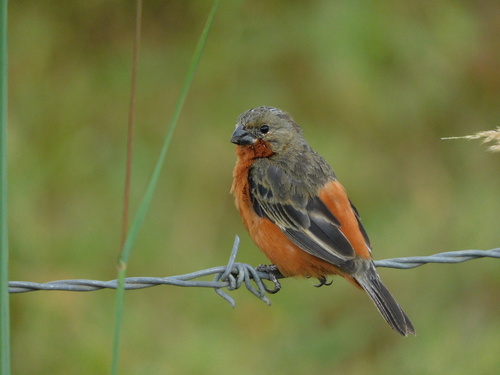
Rufous-browed Tyrannulet vs Ruddy-breasted Seedeater
Phylloscartes superciliaris versus Sporophila minuta
Play a quiz with Rufous-browed Tyrannulet and Ruddy-breasted Seedeater

Rufous-browed Tyrannulet
Ruddy-breasted Seedeater
In short
The Rufous-browed Tyrannulet and the Ruddy-breasted Seedeater are distinct in both structure and habitat. The Tyrannulet is a canopy-dwelling insectivore with a slender bill, while the Seedeater is a ground-foraging granivore with a stout bill. These differences are key for identification in the field.
Identification tips
1. Bill Shape: Look for a slender bill in the Rufous-browed Tyrannulet versus a stout, conical bill in the Ruddy-breasted Seedeater. 2. Eyebrow: The Tyrannulet has a rufous eyebrow, absent in the Seedeater. 3. Habitat: Note the elevation and forest presence for the Tyrannulet, compared to open, grassy areas for the Seedeater. 4. Behavior: Observe canopy activity for the Tyrannulet and ground-level foraging for the Seedeater.
Size
The Rufous-browed Tyrannulet is generally smaller and more slender than the Ruddy-breasted Seedeater, which has a more robust build.
Plumage
The Rufous-browed Tyrannulet features a distinctive rufous eyebrow and a more uniform olive-green plumage. In contrast, the Ruddy-breasted Seedeater has a more contrasting plumage with a ruddy breast and a darker head, especially in males.
Behaviour
Rufous-browed Tyrannulets are often seen in the canopy, joining mixed-species flocks, while Ruddy-breasted Seedeaters are more likely found foraging in flocks on the ground or in low vegetation.
Habitat
The Tyrannulet is typically found in montane forests at elevations of 600-2000 m, whereas the Seedeater is more common in open areas and grasslands.
Voice
Vocalizations are not well-documented for the Rufous-browed Tyrannulet. The Ruddy-breasted Seedeater has a simple, repetitive song typical of Sporophila species.
Rufous-browed Tyrannulet · Ruddy-breasted Seedeater · My Tricky Birds