Birdr

Rufous-tailed Scrub Robin vs Common Nightingale

Cercotrichas galactotes versus Luscinia megarhynchos

Play a quiz with Rufous-tailed Scrub Robin and Common Nightingale
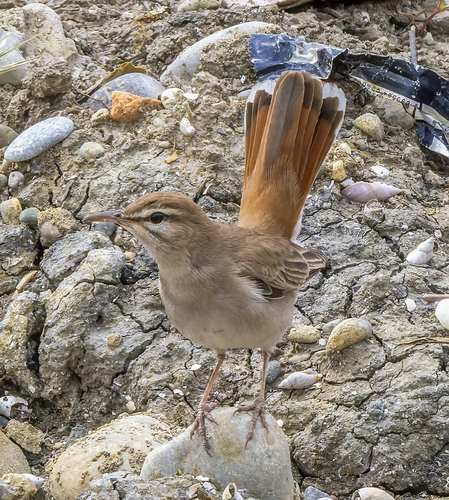
Rufous-tailed Scrub Robin (Cercotrichas galactotes) Rufous-tailed Scrub Robin
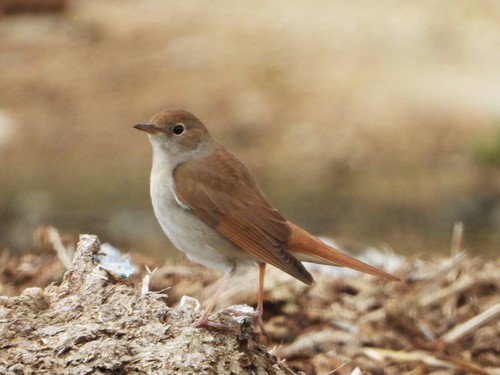
Common Nightingale (Luscinia megarhynchos) Common Nightingale

Media

Loading…

In short

The Rufous-tailed Scrub Robin and Common Nightingale can be distinguished by tail and habitat preferences. The Scrub Robin has a distinctive rufous tail with a black subterminal band and white tips, while the Nightingale has a plain rusty brown tail. The Scrub Robin is more likely found in open scrub and semi-arid habitats, whereas the Nightingale prefers dense underbrush.

Identification tips

Size

Both species are similar in size, but the Common Nightingale is slightly more robust.

Plumage

The Rufous-tailed Scrub Robin has a rufous tail with a black subterminal band and white tips, and a more contrasting supercilium. The Common Nightingale has plain brown upperparts and a rusty brown tail without the distinctive banding.

Behaviour

The Rufous-tailed Scrub Robin often perches openly and flicks its tail, while the Common Nightingale stays hidden in dense cover and is more often heard than seen.

Habitat

The Rufous-tailed Scrub Robin prefers open scrub and semi-arid habitats, while the Common Nightingale is found in dense underbrush and woodland edges.

Voice

The Common Nightingale is renowned for its rich, melodious song, often delivered from deep cover. The Rufous-tailed Scrub Robin's song is less musical and more varied.

Submit a better description

Use the same sections as the comparison. Your text is published immediately.

The Rufous-tailed Scrub Robin and Common Nightingale can be distinguished by tail and habitat preferences. The Scrub Robin has a distinctive rufous tail with a black subterminal band and white tips, while the Nightingale has a plain rusty brown tail. The Scrub Robin is more likely found in open scrub and semi-arid habitats, whereas the Nightingale prefers dense underbrush.

  • Look for the rufous tail with black and white markings on the Scrub Robin.
  • Note the preference for open habitats in the Scrub Robin versus dense cover for the Nightingale.
  • Listen for the rich song of the Nightingale, often heard but not seen.
  • Observe tail-flicking behavior in the Scrub Robin.

Both species are similar in size, but the Common Nightingale is slightly more robust.

The Rufous-tailed Scrub Robin has a rufous tail with a black subterminal band and white tips, and a more contrasting supercilium. The Common Nightingale has plain brown upperparts and a rusty brown tail without the distinctive banding.

The Rufous-tailed Scrub Robin often perches openly and flicks its tail, while the Common Nightingale stays hidden in dense cover and is more often heard than seen.

The Rufous-tailed Scrub Robin prefers open scrub and semi-arid habitats, while the Common Nightingale is found in dense underbrush and woodland edges.

The Common Nightingale is renowned for its rich, melodious song, often delivered from deep cover. The Rufous-tailed Scrub Robin's song is less musical and more varied.

Discard your changes?

You have unsaved edits. If you leave now, those changes will be lost.

Rufous-tailed Scrub Robin · Common Nightingale · My Tricky Birds