Birdr

Rufous Turtle Dove vs Collared Dove

Streptopelia orientalis versus Streptopelia decaocto

Play a quiz with Rufous Turtle Dove and Collared Dove
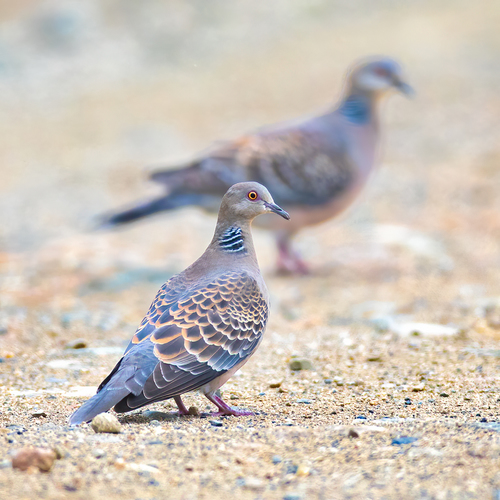
Rufous Turtle Dove (Streptopelia orientalis) Rufous Turtle Dove
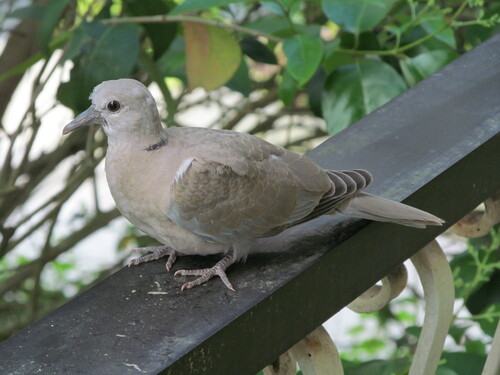
Collared Dove (Streptopelia decaocto) Collared Dove

Media

Loading…

In short

The most reliable field mark to separate Rufous Turtle Dove from Collared Dove is the presence or absence of a bare eye-ring: Collared Dove shows a small patch of bare skin around the eye (white or yellow), while Rufous Turtle Dove lacks this. In addition, Rufous Turtle Dove has a scaly, brown-toned wing pattern with darker feather centers, and its neck patch is made of silver-tipped feathers forming black-and-white stripes, while Collared Dove has a neat black half-collar edged with white. Collared Dove is generally a uniform pale grey-buff with a blue-grey underwing patch, and its tail is tipped white below. Both are similar in size, but Rufous Turtle Dove is slightly bulkier and has a more relaxed, direct flight. Juvenile and immature-specific wing patterns are not described in detail for either species, so focus on head, neck, and wing coloration for field separation.

Identification tips

  1. Bare eye-ring: Collared Dove has a small area of bare skin around the eye (white or yellow), visible at close range; Rufous Turtle Dove lacks this feature. This is a strong separator in perched birds.
  2. Neck patch: Collared Dove shows a sharp black half-collar edged with white on the nape; Rufous Turtle Dove has a black-and-white striped patch made of silver-tipped feathers on the side of the neck, which may appear less crisp.
  3. Wing pattern: Rufous Turtle Dove's wing coverts are brown with darker centers, creating a scaly or patterned look; Collared Dove's wings are plain grey-buff to pinkish-grey, lacking strong patterning.
  4. Breast color: Rufous Turtle Dove's breast is less pink than European Turtle Dove, and generally less pinkish than Collared Dove, which can show a pinkish-grey tone.
  5. Tail tip: Collared Dove's tail is tipped white below and the outer tail feathers are also tipped whitish above; Rufous Turtle Dove's tail tip color varies by subspecies (white or grey), but the tail is always wedge-shaped. This mark is variable and not always reliable.
  6. Underwing: Collared Dove has a blue-grey underwing patch, often visible in flight; Rufous Turtle Dove lacks this distinct patch.
  7. Head and face: Collared Dove is uniform grey-buff with a pale face; Rufous Turtle Dove may show more contrast between the brownish wings and the rest of the body.
  8. Flight style: Collared Dove typically flies with fast, clipped wingbeats and little gliding; Rufous Turtle Dove's flight is more relaxed and direct, with more gliding in display.
  9. Display flight: Collared Dove's display is a steep climb and long glide with wings in an inverted 'V'; Rufous Turtle Dove's display involves noisy wing flapping and a gliding descent with spread tail.
  10. Juvenile marks: Collared Dove juveniles lack a well-developed collar and have a brown iris; no distinctive juvenile marks are described for Rufous Turtle Dove, so beware of immature Collared Doves lacking the collar.
  11. Habitat: Collared Dove is almost always near human habitation; Rufous Turtle Dove is more likely in woodland or forest away from settlements.
  12. Eye color: Collared Dove has a red iris (appears dark from a distance); Rufous Turtle Dove's eye color is not described, but the absence of a bare eye-ring is key.
  13. Subspecies variation: Rufous Turtle Dove subspecies may show differences in tail tip color (white or grey) and head color (reddish-brown in S. o. erythrocephala), so beware of variation.
  14. Perched jizz: Rufous Turtle Dove may appear bulkier and more patterned on the wing than the smooth, pale Collared Dove.
  15. Pitfalls: Both species can show a wedge-shaped tail and similar size; focus on head and wing pattern, and presence/absence of bare eye-ring for best separation.

Size

Both species are medium-sized doves, with Collared Dove averaging around 193 g in body mass. Rufous Turtle Dove is described as a little larger and bulkier than the European Turtle Dove, and about the same size as Collared Dove. In the field, size alone is not a reliable separator, but Rufous Turtle Dove may appear slightly more robust. Both have similar overall proportions and wedge-shaped tails.

Plumage

No distinctive juvenile or immature upperwing pattern is described for either species, so focus is on adult and general plumage. Rufous Turtle Dove has a brownish wing with darker centers to the feathers, giving a scaly appearance, and the breast is less pink than that of Turtle Dove. Its neck patch is a black-and-white striped area made of silver-tipped feathers. The tail is wedge-shaped, with subspecies variation in the color of the terminal tail band (white or grey). Collared Dove is a uniform grey-buff to pinkish-grey, with a blue-grey underwing patch and a distinctive black half-collar edged with white on the nape. The tail is grey-buff above, dark grey below, and tipped white. Collared Dove has a small bare patch of skin around the eye, which is absent in Rufous Turtle Dove. Juveniles of Collared Dove lack a well-developed collar and have a brown iris, but otherwise resemble adults. No detailed juvenile description is given for Rufous Turtle Dove.

Behaviour

Both species have display flights, but Collared Dove's is a rapid, near-vertical climb followed by a long circular glide with wings held in an inverted 'V'. Rufous Turtle Dove's display involves noisy wing flapping, shooting up, and gliding down with the tail spread. In normal flight, Collared Dove uses fast, clipped wingbeats and rarely glides, while Rufous Turtle Dove's flight is more relaxed and direct. Both species perch in trees and nest at mid-canopy height, but Collared Dove is more closely associated with human habitation.

Habitat

Collared Dove is strongly associated with human settlements, often nesting within 1 km of buildings and thriving in suburban and agricultural landscapes. Rufous Turtle Dove has a wider range across Asia and is less tied to human habitation, occurring in woodlands and forests. In winter, both may be found in open country, but Collared Dove is much more likely in urban or suburban settings.

Submit a better description

Use the same sections as the comparison. Your text is published immediately.

The most reliable field mark to separate Rufous Turtle Dove from Collared Dove is the presence or absence of a bare eye-ring: Collared Dove shows a small patch of bare skin around the eye (white or yellow), while Rufous Turtle Dove lacks this. In addition, Rufous Turtle Dove has a scaly, brown-toned wing pattern with darker feather centers, and its neck patch is made of silver-tipped feathers forming black-and-white stripes, while Collared Dove has a neat black half-collar edged with white. Collared Dove is generally a uniform pale grey-buff with a blue-grey underwing patch, and its tail is tipped white below. Both are similar in size, but Rufous Turtle Dove is slightly bulkier and has a more relaxed, direct flight. Juvenile and immature-specific wing patterns are not described in detail for either species, so focus on head, neck, and wing coloration for field separation.

  1. Bare eye-ring: Collared Dove has a small area of bare skin around the eye (white or yellow), visible at close range; Rufous Turtle Dove lacks this feature. This is a strong separator in perched birds.
  2. Neck patch: Collared Dove shows a sharp black half-collar edged with white on the nape; Rufous Turtle Dove has a black-and-white striped patch made of silver-tipped feathers on the side of the neck, which may appear less crisp.
  3. Wing pattern: Rufous Turtle Dove's wing coverts are brown with darker centers, creating a scaly or patterned look; Collared Dove's wings are plain grey-buff to pinkish-grey, lacking strong patterning.
  4. Breast color: Rufous Turtle Dove's breast is less pink than European Turtle Dove, and generally less pinkish than Collared Dove, which can show a pinkish-grey tone.
  5. Tail tip: Collared Dove's tail is tipped white below and the outer tail feathers are also tipped whitish above; Rufous Turtle Dove's tail tip color varies by subspecies (white or grey), but the tail is always wedge-shaped. This mark is variable and not always reliable.
  6. Underwing: Collared Dove has a blue-grey underwing patch, often visible in flight; Rufous Turtle Dove lacks this distinct patch.
  7. Head and face: Collared Dove is uniform grey-buff with a pale face; Rufous Turtle Dove may show more contrast between the brownish wings and the rest of the body.
  8. Flight style: Collared Dove typically flies with fast, clipped wingbeats and little gliding; Rufous Turtle Dove's flight is more relaxed and direct, with more gliding in display.
  9. Display flight: Collared Dove's display is a steep climb and long glide with wings in an inverted 'V'; Rufous Turtle Dove's display involves noisy wing flapping and a gliding descent with spread tail.
  10. Juvenile marks: Collared Dove juveniles lack a well-developed collar and have a brown iris; no distinctive juvenile marks are described for Rufous Turtle Dove, so beware of immature Collared Doves lacking the collar.
  11. Habitat: Collared Dove is almost always near human habitation; Rufous Turtle Dove is more likely in woodland or forest away from settlements.
  12. Eye color: Collared Dove has a red iris (appears dark from a distance); Rufous Turtle Dove's eye color is not described, but the absence of a bare eye-ring is key.
  13. Subspecies variation: Rufous Turtle Dove subspecies may show differences in tail tip color (white or grey) and head color (reddish-brown in S. o. erythrocephala), so beware of variation.
  14. Perched jizz: Rufous Turtle Dove may appear bulkier and more patterned on the wing than the smooth, pale Collared Dove.
  15. Pitfalls: Both species can show a wedge-shaped tail and similar size; focus on head and wing pattern, and presence/absence of bare eye-ring for best separation.

Both species are medium-sized doves, with Collared Dove averaging around 193 g in body mass. Rufous Turtle Dove is described as a little larger and bulkier than the European Turtle Dove, and about the same size as Collared Dove. In the field, size alone is not a reliable separator, but Rufous Turtle Dove may appear slightly more robust. Both have similar overall proportions and wedge-shaped tails.

No distinctive juvenile or immature upperwing pattern is described for either species, so focus is on adult and general plumage. Rufous Turtle Dove has a brownish wing with darker centers to the feathers, giving a scaly appearance, and the breast is less pink than that of Turtle Dove. Its neck patch is a black-and-white striped area made of silver-tipped feathers. The tail is wedge-shaped, with subspecies variation in the color of the terminal tail band (white or grey). Collared Dove is a uniform grey-buff to pinkish-grey, with a blue-grey underwing patch and a distinctive black half-collar edged with white on the nape. The tail is grey-buff above, dark grey below, and tipped white. Collared Dove has a small bare patch of skin around the eye, which is absent in Rufous Turtle Dove. Juveniles of Collared Dove lack a well-developed collar and have a brown iris, but otherwise resemble adults. No detailed juvenile description is given for Rufous Turtle Dove.

Both species have display flights, but Collared Dove's is a rapid, near-vertical climb followed by a long circular glide with wings held in an inverted 'V'. Rufous Turtle Dove's display involves noisy wing flapping, shooting up, and gliding down with the tail spread. In normal flight, Collared Dove uses fast, clipped wingbeats and rarely glides, while Rufous Turtle Dove's flight is more relaxed and direct. Both species perch in trees and nest at mid-canopy height, but Collared Dove is more closely associated with human habitation.

Collared Dove is strongly associated with human settlements, often nesting within 1 km of buildings and thriving in suburban and agricultural landscapes. Rufous Turtle Dove has a wider range across Asia and is less tied to human habitation, occurring in woodlands and forests. In winter, both may be found in open country, but Collared Dove is much more likely in urban or suburban settings.

Discard your changes?

You have unsaved edits. If you leave now, those changes will be lost.

Rufous Turtle Dove · Collared Dove · My Tricky Birds