
Russet-mantled Foliage-gleaner vs Buff-fronted Foliage-gleaner
Syndactyla dimidiata versus Dendroma rufa
Play a quiz with Russet-mantled Foliage-gleaner and Buff-fronted Foliage-gleaner
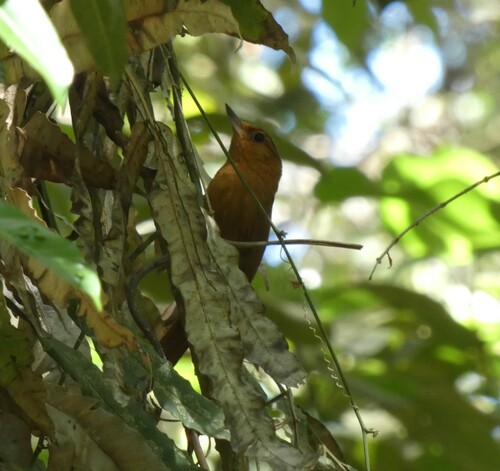 Russet-mantled Foliage-gleaner
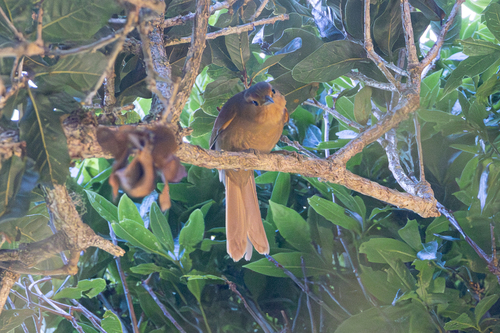 Buff-fronted Foliage-gleaner
In short
The most reliable field mark between Russet-mantled (Planalto) Foliage-gleaner and Buff-fronted Foliage-gleaner is the head and upperparts coloration: Russet-mantled shows a rich rufescent-orange face and bright rufescent brown crown and back, while Buff-fronted has a distinctive ochraceous (buff) forehead and supercilium set off against a dull brownish gray crown and back. Juvenile Russet-mantled can show a whitish throat and brown-barred breast, while juvenile Buff-fronted has a narrower buff forehead and paler crown. Both species have rufous tones in the wings and tail, but the distribution and intensity differ. Structure is similar, but Buff-fronted is slightly larger and bulkier. Use head pattern and upperpart color as your primary separation, especially in perched or slow-moving birds.
Identification tips
- Head pattern is key: Russet-mantled has a rich rufescent-orange face with deeper color on the supercilium and darker ear coverts, blending into a bright rufescent brown crown. Buff-fronted has a broad ochraceous (buff) forehead and supercilium, sharply set off from a dull brownish gray crown and upper back.
- Crown and back color: Russet-mantled is bright rufescent brown with a cinnamon tinge across crown and upperparts; Buff-fronted is dull brownish gray on the crown and upper back, becoming ochraceous brown on the lower back and rump.
- Juvenile marks: Juvenile Russet-mantled shows a whitish throat and brown-barred breast (unique among these two), while juvenile Buff-fronted has a narrower buff forehead, paler crown, and darker, more rufescent underparts but no breast barring.
- Bill structure: Juvenile Russet-mantled has a noticeably shorter bill than adults, which may make it look less robust-headed than Buff-fronted at the same age.
- Wing coloration: Russet-mantled's wings are dark rufescent brown with brighter edges on the primaries; Buff-fronted's wings are mostly bright rufous with darker primary coverts. In flight, Buff-fronted may show more contrast between the rufous wing and duller back.
- Tail color: Russet-mantled has a rufous-chestnut tail; Buff-fronted's tail is dull rufous-brown with pointed feather tips. The difference is subtle but can be useful if seen well.
- Underparts: Russet-mantled's underparts are ochraceous rufous with faint pale streaks on the breast and an olive cast on the flanks; Buff-fronted's throat and breast are glowing ochraceous, fading to duller ochraceous on the belly and flanks, with no streaking or olive cast.
- Supercilium: Buff-fronted's supercilium is broad and ochraceous, very obvious; Russet-mantled's is rufescent and blends more with the rest of the face.
- Ear coverts: Russet-mantled's are darker rufescent; Buff-fronted's are ochraceous, matching the supercilium and forehead.
- Habitat context: If you are outside the southern Brazilian planalto or eastern Paraguay, Buff-fronted is far more likely. In the planalto/cerrado region, both are possible, but Russet-mantled is rare and sensitive to disturbance.
- Behavior: Both forage in similar ways, so behavior is not a strong separator.
- Voice: If you hear a slowly ascending 'tsjek' series like a small motorbike, favor Russet-mantled. Otherwise, voice is not a reliable separator without more detail for Buff-fronted.
- Size: Buff-fronted is slightly larger and bulkier, but the difference is subtle and not reliable without direct comparison.
- Sexes: Both species are sexually monomorphic in plumage, so sex is not a separator.
- Pitfalls: Do not rely on overall rufous tones alone—Buff-fronted can look quite rufous in the wings and tail, but the head and upper back are always duller and more contrasting with the buff forehead, unlike the more uniform rufescent head and back of Russet-mantled.
Size
Buff-fronted Foliage-gleaner is slightly larger (18–19 cm, 25–36 g) than Russet-mantled (about 17 cm, 27–32 g), but the overlap is considerable and size alone is not reliable in the field. Both are medium to largish foliage-gleaners, but Buff-fronted may appear a bit bulkier overall. Bill length is not notably different except that juvenile Russet-mantled has a shorter bill than adults, which may make them look slightly less robust-headed than Buff-fronted.
Plumage
- Juveniles: Juvenile Russet-mantled Foliage-gleaner has a shorter bill, a whitish throat, and brown bars on the breast, which is unique among these two; juvenile Buff-fronted has a narrower buff forehead, paler crown, and darker, more rufescent underparts but lacks the barred breast and whitish throat.
- Adults: Russet-mantled has a rich rufescent-orange face (especially supercilium), bright rufescent brown crown and upperparts, and a rufous-chestnut tail. Its wings are dark rufescent brown with brighter edges. Underparts are ochraceous rufous with faint pale streaks on the breast and an olive cast on the flanks. Buff-fronted has a broad ochraceous (buff) forehead and supercilium, a dull brownish gray crown and upper back, ochraceous brown lower back and rump, and a dull rufous-brown tail with pointed tips. Its wings are bright rufous with darker primary coverts. Underparts are glowing ochraceous on throat and breast, fading to duller ochraceous on belly and flanks. The head pattern is more contrasting in Buff-fronted, with a clear buff front and supercilium, while Russet-mantled is more uniformly rufescent throughout the head and back.
Behaviour
Both species forage in the forest understory to midstory, often in pairs or as part of mixed-species flocks. Russet-mantled is most often seen in pairs and rarely in disturbed forest, while Buff-fronted is also a forest interior species but may be more adaptable to a range of forest types. Foraging behavior is similar: gleaning from branches and epiphytes. No major behavioral separation is noted in the sources.
Habitat
Russet-mantled Foliage-gleaner is restricted to the southern Brazilian planalto and adjacent eastern Paraguay, inhabiting lowland tropical evergreen forest, gallery forest, and woodlands within the cerrado, generally from 100–1,200 m elevation. It is rare and sensitive to disturbance. Buff-fronted Foliage-gleaner is more widespread in the Neotropics and can be found in a broader range of forested habitats, including montane and lowland forests, and is not as closely tied to the planalto or cerrado. If you are in central/southern Brazil or eastern Paraguay in undisturbed forest, both are possible, but Buff-fronted is much more widespread elsewhere.
Voice
Russet-mantled's song is described as a short or very long series of 'tsjek' notes, ascending and starting/ending with some stuttering, likened to a small, slowly starting motorbike. Its contact call is a loud, nasal 'cheh', single or doubled. No detailed vocal description is given for Buff-fronted in the notes, so voice is not a reliable separator unless you know Russet-mantled's distinctive 'motorbike' song.
Russet-mantled Foliage-gleaner · Buff-fronted Foliage-gleaner · My Tricky Birds