
Birdr

Russet-mantled Foliage-gleaner vs Chestnut-capped Foliage-gleaner

Syndactyla dimidiata versus Clibanornis rectirostris

Play a quiz with Russet-mantled Foliage-gleaner and Chestnut-capped Foliage-gleaner
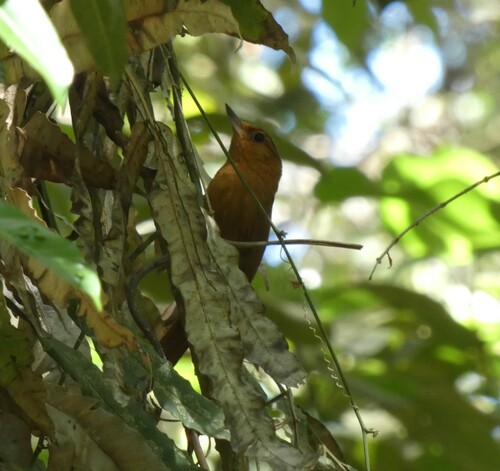
Russet-mantled Foliage-gleaner (Syndactyla dimidiata) Russet-mantled Foliage-gleaner
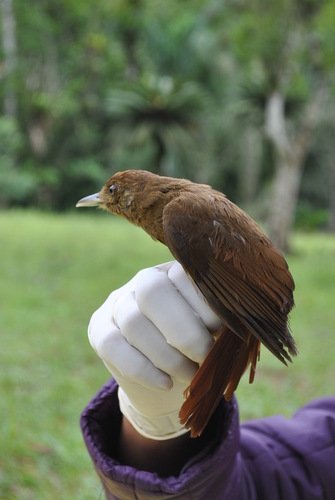
Chestnut-capped Foliage-gleaner (Clibanornis rectirostris) Chestnut-capped Foliage-gleaner

Media

Loading…

In short

The Russet-mantled Foliage-gleaner and the Chestnut-capped Foliage-gleaner can be distinguished by their head coloration and vocalizations. The Russet-mantled has a russet mantle and lacks the distinctive chestnut cap of the Chestnut-capped. Vocalizations also differ, with the Chestnut-capped having a unique call described as a 'demented' domestic fowl.

Identification tips

  1. Look for the chestnut cap on the Chestnut-capped Foliage-gleaner. 2. Listen for the unique vocalization of the Chestnut-capped, which sounds like a 'demented' domestic fowl. 3. Note the russet mantle of the Russet-mantled Foliage-gleaner, which lacks the distinct cap of its relative.

Size

Both species are similar in size, typical of foliage-gleaners, with no notable size difference.

Plumage

The Russet-mantled Foliage-gleaner has a russet mantle and lacks a distinct cap, while the Chestnut-capped Foliage-gleaner features a prominent chestnut-colored cap and a more uniformly rufous body.

Behaviour

Both species exhibit typical foliage-gleaner behavior, foraging actively in dense vegetation.

Habitat

Both species inhabit forested areas, but specific habitat preferences are not detailed in the sources.

Voice

The Chestnut-capped Foliage-gleaner is noted for its distinctive vocalizations resembling a 'demented' domestic fowl, which is a key auditory field mark.

Submit a better description

Use the same sections as the comparison. Your text is published immediately.

The Russet-mantled Foliage-gleaner and the Chestnut-capped Foliage-gleaner can be distinguished by their head coloration and vocalizations. The Russet-mantled has a russet mantle and lacks the distinctive chestnut cap of the Chestnut-capped. Vocalizations also differ, with the Chestnut-capped having a unique call described as a 'demented' domestic fowl.

  1. Look for the chestnut cap on the Chestnut-capped Foliage-gleaner. 2. Listen for the unique vocalization of the Chestnut-capped, which sounds like a 'demented' domestic fowl. 3. Note the russet mantle of the Russet-mantled Foliage-gleaner, which lacks the distinct cap of its relative.

Both species are similar in size, typical of foliage-gleaners, with no notable size difference.

The Russet-mantled Foliage-gleaner has a russet mantle and lacks a distinct cap, while the Chestnut-capped Foliage-gleaner features a prominent chestnut-colored cap and a more uniformly rufous body.

Both species exhibit typical foliage-gleaner behavior, foraging actively in dense vegetation.

Both species inhabit forested areas, but specific habitat preferences are not detailed in the sources.

The Chestnut-capped Foliage-gleaner is noted for its distinctive vocalizations resembling a 'demented' domestic fowl, which is a key auditory field mark.

Discard your changes?

You have unsaved edits. If you leave now, those changes will be lost.

Russet-mantled Foliage-gleaner · Chestnut-capped Foliage-gleaner · My Tricky Birds