Birdr

Rusty Blackbird vs Black-headed Grosbeak

Euphagus carolinus versus Pheucticus melanocephalus

Play a quiz with Rusty Blackbird and Black-headed Grosbeak
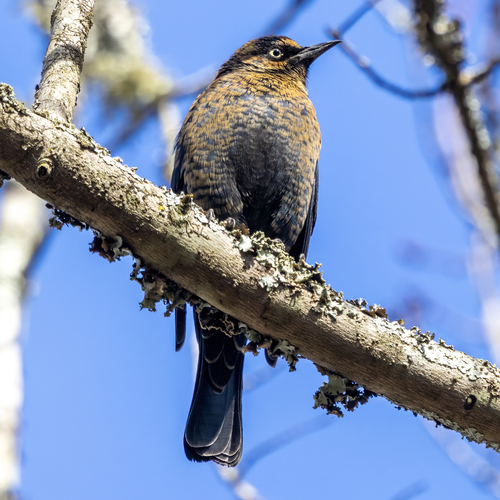
Rusty Blackbird (Euphagus carolinus) Rusty Blackbird
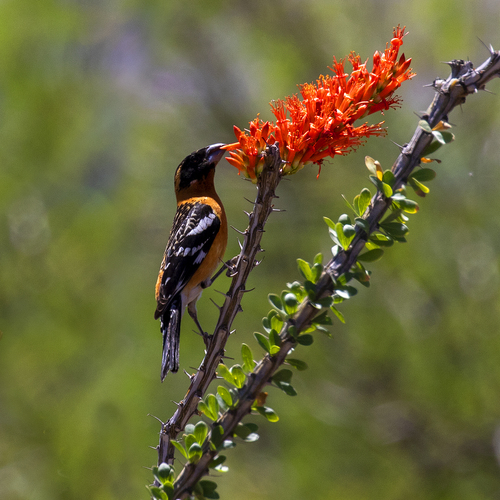
Black-headed Grosbeak (Pheucticus melanocephalus) Black-headed Grosbeak

Media

Loading…

In short

The Rusty Blackbird and Black-headed Grosbeak are distinct in both appearance and habitat preferences. The Rusty Blackbird is more uniformly dark with rusty edges in fall and winter, while the Black-headed Grosbeak has a striking black head and orange breast. These species are unlikely to be confused in the field due to their differing habitats and behaviors.

Identification tips

  1. Location: Rusty Blackbirds are found in wet, northern habitats, while Black-headed Grosbeaks are in woodlands. 2. Plumage: Look for the rusty feather edges on the Rusty Blackbird, especially in fall and winter. 3. Head Color: The Black-headed Grosbeak has a distinctive black head and orange breast. 4. Vocalization: Listen for the rusty-hinge song of the Rusty Blackbird versus the melodious song of the Black-headed Grosbeak.

Size

The Black-headed Grosbeak is generally larger and more robust than the Rusty Blackbird.

Plumage

Rusty Blackbirds are dark with rusty edges on their feathers in fall and winter, whereas Black-headed Grosbeaks have a black head, orange breast, and white wing patches. Female and immature grosbeaks are brownish with streaked underparts.

Behaviour

Rusty Blackbirds are often found probing in mud and vegetation along wetlands, while Black-headed Grosbeaks are more likely to be seen in trees or shrubs, often feeding on seeds and fruits.

Habitat

Rusty Blackbirds prefer wet forests, bogs, and swamps, especially in northern regions. Black-headed Grosbeaks are typically found in deciduous and mixed woodlands across western North America.

Voice

Rusty Blackbirds have a creaky, rusty-hinge-like song, whereas Black-headed Grosbeaks have a rich, melodious song similar to an American Robin.

Submit a better description

Use the same sections as the comparison. Your text is published immediately.

The Rusty Blackbird and Black-headed Grosbeak are distinct in both appearance and habitat preferences. The Rusty Blackbird is more uniformly dark with rusty edges in fall and winter, while the Black-headed Grosbeak has a striking black head and orange breast. These species are unlikely to be confused in the field due to their differing habitats and behaviors.

  1. Location: Rusty Blackbirds are found in wet, northern habitats, while Black-headed Grosbeaks are in woodlands. 2. Plumage: Look for the rusty feather edges on the Rusty Blackbird, especially in fall and winter. 3. Head Color: The Black-headed Grosbeak has a distinctive black head and orange breast. 4. Vocalization: Listen for the rusty-hinge song of the Rusty Blackbird versus the melodious song of the Black-headed Grosbeak.

The Black-headed Grosbeak is generally larger and more robust than the Rusty Blackbird.

Rusty Blackbirds are dark with rusty edges on their feathers in fall and winter, whereas Black-headed Grosbeaks have a black head, orange breast, and white wing patches. Female and immature grosbeaks are brownish with streaked underparts.

Rusty Blackbirds are often found probing in mud and vegetation along wetlands, while Black-headed Grosbeaks are more likely to be seen in trees or shrubs, often feeding on seeds and fruits.

Rusty Blackbirds prefer wet forests, bogs, and swamps, especially in northern regions. Black-headed Grosbeaks are typically found in deciduous and mixed woodlands across western North America.

Rusty Blackbirds have a creaky, rusty-hinge-like song, whereas Black-headed Grosbeaks have a rich, melodious song similar to an American Robin.

Discard your changes?

You have unsaved edits. If you leave now, those changes will be lost.

Rusty Blackbird · Black-headed Grosbeak · My Tricky Birds