Birdr

Rusty-cheeked Hornbill vs Oriental Pied-Hornbill

Anorrhinus tickelli versus Anthracoceros albirostris

Play a quiz with Rusty-cheeked Hornbill and Oriental Pied-Hornbill
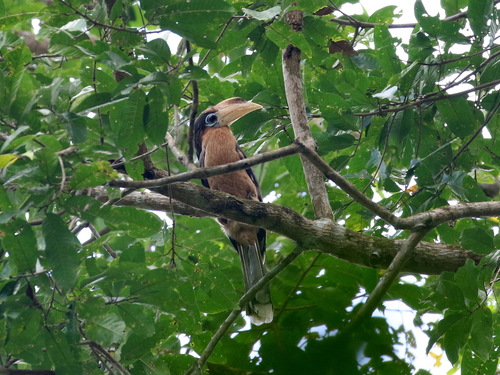
Rusty-cheeked Hornbill (Anorrhinus tickelli) Rusty-cheeked Hornbill
Oriental Pied-Hornbill (Anthracoceros albirostris) Oriental Pied-Hornbill

Media

Loading…

In short

The Rusty-cheeked Hornbill and the Oriental Pied-Hornbill can be distinguished by their bill and plumage. The Rusty-cheeked Hornbill has a more pronounced rusty coloration on its cheeks and a larger casque, while the Oriental Pied-Hornbill displays a distinctive black and white plumage with a smaller casque.

Identification tips

  1. Bill and Casque: Look for the larger casque and rusty cheeks on the Rusty-cheeked Hornbill. 2. Plumage: Note the black and white contrast of the Oriental Pied-Hornbill. 3. Habitat: Consider the forest type; denser forests may indicate Rusty-cheeked. 4. Vocalizations: Listen for deeper calls from the Rusty-cheeked Hornbill.

Size

Both species are similar in size, but the Rusty-cheeked Hornbill tends to appear bulkier due to its larger casque.

Plumage

The Rusty-cheeked Hornbill has a rusty-brown cheek patch and overall darker plumage, whereas the Oriental Pied-Hornbill features a striking black and white contrast with a white belly and underparts.

Behaviour

Both species exhibit similar hornbill behaviors, such as fruit foraging and cavity nesting, but the Oriental Pied-Hornbill is more commonly observed in pairs or small groups.

Habitat

Both species inhabit forests, but the Rusty-cheeked Hornbill is more often found in dense, evergreen forests, while the Oriental Pied-Hornbill is adaptable to a variety of forest types, including secondary growth and edges.

Voice

The Rusty-cheeked Hornbill has a deeper, more resonant call compared to the Oriental Pied-Hornbill, which produces a series of higher-pitched, repetitive notes.

Submit a better description

Use the same sections as the comparison. Your text is published immediately.

The Rusty-cheeked Hornbill and the Oriental Pied-Hornbill can be distinguished by their bill and plumage. The Rusty-cheeked Hornbill has a more pronounced rusty coloration on its cheeks and a larger casque, while the Oriental Pied-Hornbill displays a distinctive black and white plumage with a smaller casque.

  1. Bill and Casque: Look for the larger casque and rusty cheeks on the Rusty-cheeked Hornbill. 2. Plumage: Note the black and white contrast of the Oriental Pied-Hornbill. 3. Habitat: Consider the forest type; denser forests may indicate Rusty-cheeked. 4. Vocalizations: Listen for deeper calls from the Rusty-cheeked Hornbill.

Both species are similar in size, but the Rusty-cheeked Hornbill tends to appear bulkier due to its larger casque.

The Rusty-cheeked Hornbill has a rusty-brown cheek patch and overall darker plumage, whereas the Oriental Pied-Hornbill features a striking black and white contrast with a white belly and underparts.

Both species exhibit similar hornbill behaviors, such as fruit foraging and cavity nesting, but the Oriental Pied-Hornbill is more commonly observed in pairs or small groups.

Both species inhabit forests, but the Rusty-cheeked Hornbill is more often found in dense, evergreen forests, while the Oriental Pied-Hornbill is adaptable to a variety of forest types, including secondary growth and edges.

The Rusty-cheeked Hornbill has a deeper, more resonant call compared to the Oriental Pied-Hornbill, which produces a series of higher-pitched, repetitive notes.

Discard your changes?

You have unsaved edits. If you leave now, those changes will be lost.

Rusty-cheeked Hornbill · Oriental Pied-Hornbill · My Tricky Birds