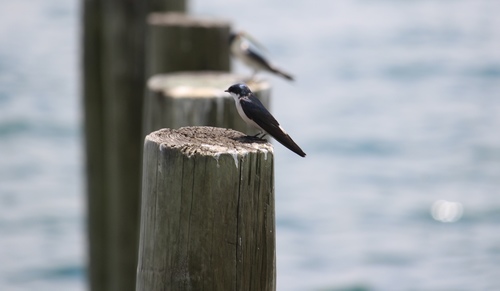
Sand Martin vs Mangrove Swallow
Riparia riparia versus Tachycineta albilinea
Play a quiz with Sand Martin and Mangrove Swallow

Sand Martin
Mangrove Swallow
In short
The Sand Martin and Mangrove Swallow are both small swallows, but they can be distinguished by plumage and habitat. The Sand Martin has a brown back and a distinctive brown breast band, while the Mangrove Swallow has a glossy blue-green back and a white supraloral streak. Habitat preferences also differ significantly, with Sand Martins favoring open areas near water and Mangrove Swallows inhabiting coastal mangroves.
Identification tips
- Plumage: Look for the Sand Martin's brown breast band versus the Mangrove Swallow's glossy blue-green back and white supraloral streak.
- Habitat: Note the habitat; Sand Martins are in open areas near water, while Mangrove Swallows are in coastal mangroves.
- Behavior: Observe social behavior; Sand Martins are often in colonies, whereas Mangrove Swallows are more solitary.
Size
Both species are small swallows with similar size and structure.
Plumage
The Sand Martin has a brown back and a brown breast band, contrasting with the Mangrove Swallow's glossy blue-green back and white underparts with a gray wash. The Mangrove Swallow also features a distinctive white supraloral streak.
Behaviour
Both species exhibit typical swallow flight patterns, but Sand Martins are often seen in large colonies, while Mangrove Swallows are more solitary or in small groups.
Habitat
Sand Martins are found near open areas with water, such as rivers and lakes, often nesting in sandbanks. Mangrove Swallows are typically found in coastal mangrove habitats.
Voice
Vocalizations are not the most reliable distinguishing feature, but Sand Martins have a dry, chattering call, while Mangrove Swallows' calls are less documented.