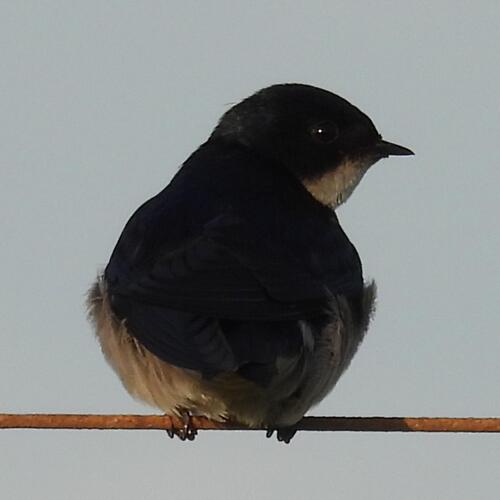
Sand Martin vs Pearl-breasted Swallow
Riparia riparia versus Hirundo dimidiata
Play a quiz with Sand Martin and Pearl-breasted Swallow

Sand Martin
Pearl-breasted Swallow
In short
The Sand Martin (Riparia riparia) and Pearl-breasted Swallow (Hirundo dimidiata) can be distinguished by their plumage and structure. The Sand Martin has a distinctive brown band across its chest, while the Pearl-breasted Swallow lacks this band and has a more uniform white underbody. Structural differences include the Sand Martin's shorter tail compared to the Pearl-breasted Swallow's slightly forked tail.
Identification tips
1. Look for the brown chest band on the Sand Martin, absent in the Pearl-breasted Swallow. 2. Note the tail shape: Sand Martin has a shorter, less forked tail compared to the Pearl-breasted Swallow. 3. Observe the habitat: Sand Martins prefer sandy banks near water, while Pearl-breasted Swallows are more versatile in habitat choice.
Size
Both species are small swallows, but the Pearl-breasted Swallow is slightly larger with a more streamlined appearance.
Plumage
The Sand Martin has a brown upper body with a brown chest band and white underparts. The Pearl-breasted Swallow has glossy blue-black upperparts and a clean white underbody without a chest band.
Behaviour
Both species exhibit similar aerial feeding behaviors typical of swallows, but the Sand Martin often nests in colonies in sandy banks, whereas the Pearl-breasted Swallow may be found in more varied habitats.
Habitat
Sand Martins are often found near water bodies with sandy banks for nesting, while Pearl-breasted Swallows can be found in open areas, often away from water.
Voice
Vocalizations are not a primary distinguishing feature; both species have typical swallow calls.