Birdr

Sand Martin vs Red-rumped Swallow

Riparia riparia versus Cecropis daurica

Play a quiz with Sand Martin and Red-rumped Swallow

Sand Martin (Riparia riparia) Sand Martin
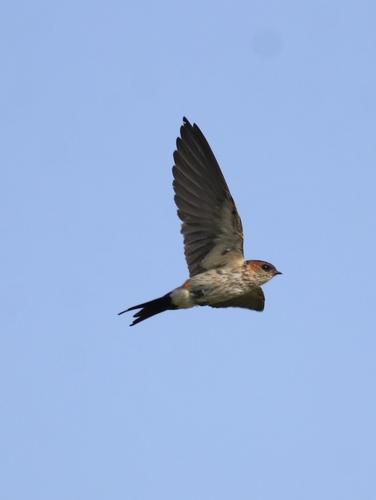
Red-rumped Swallow (Cecropis daurica) Red-rumped Swallow

Media

Loading…

In short

The Sand Martin (Riparia riparia) and Red-rumped Swallow (Cecropis daurica) are both small swallows, but can be distinguished by their tail shape and rump color. The Sand Martin has a brown back and a short, slightly forked tail, while the Red-rumped Swallow features a distinctive reddish rump and a longer, deeply forked tail.

Identification tips

1. Tail shape: Sand Martin has a short, slightly forked tail; Red-rumped Swallow has a longer, deeply forked tail. 2. Rump color: Sand Martin has a brown back; Red-rumped Swallow has a reddish rump. 3. Breast band: Sand Martin has a distinct brown breast band, which is absent in the Red-rumped Swallow. 4. Habitat preference: Consider the habitat; Sand Martins near water, Red-rumped Swallows in open country.

Size

Both species are small swallows, but the Red-rumped Swallow is slightly larger with a more robust build.

Plumage

The Sand Martin has a uniform brown back and a white underbelly with a distinct brown breast band. In contrast, the Red-rumped Swallow has a reddish-brown rump and a blue-black back with pale underparts.

Behaviour

Both species are aerial insectivores often seen in flight, but the Red-rumped Swallow is more likely to be seen gliding with its longer tail.

Habitat

Sand Martins are commonly found near water bodies with sandy banks, while Red-rumped Swallows prefer open country and are often seen near cliffs or buildings.

Voice

The Sand Martin's call is a dry, buzzing 'trrt' sound, while the Red-rumped Swallow has a more varied and musical call.

Submit a better description

Use the same sections as the comparison. Your text is published immediately.

The Sand Martin (Riparia riparia) and Red-rumped Swallow (Cecropis daurica) are both small swallows, but can be distinguished by their tail shape and rump color. The Sand Martin has a brown back and a short, slightly forked tail, while the Red-rumped Swallow features a distinctive reddish rump and a longer, deeply forked tail.

1. Tail shape: Sand Martin has a short, slightly forked tail; Red-rumped Swallow has a longer, deeply forked tail. 2. Rump color: Sand Martin has a brown back; Red-rumped Swallow has a reddish rump. 3. Breast band: Sand Martin has a distinct brown breast band, which is absent in the Red-rumped Swallow. 4. Habitat preference: Consider the habitat; Sand Martins near water, Red-rumped Swallows in open country.

Both species are small swallows, but the Red-rumped Swallow is slightly larger with a more robust build.

The Sand Martin has a uniform brown back and a white underbelly with a distinct brown breast band. In contrast, the Red-rumped Swallow has a reddish-brown rump and a blue-black back with pale underparts.

Both species are aerial insectivores often seen in flight, but the Red-rumped Swallow is more likely to be seen gliding with its longer tail.

Sand Martins are commonly found near water bodies with sandy banks, while Red-rumped Swallows prefer open country and are often seen near cliffs or buildings.

The Sand Martin's call is a dry, buzzing 'trrt' sound, while the Red-rumped Swallow has a more varied and musical call.

Discard your changes?

You have unsaved edits. If you leave now, those changes will be lost.

Sand Martin · Red-rumped Swallow · My Tricky Birds