
Sand Martin vs Western House Martin
Riparia riparia versus Delichon urbicum
Play a quiz with Sand Martin and Western House Martin
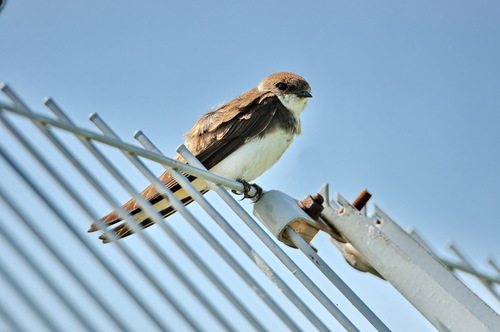
Sand Martin
Western House Martin
In short
The Sand Martin (Riparia riparia) and the Western House Martin (Delichon urbicum) are both small swallows, but they can be distinguished by their plumage and tail shape. The Sand Martin has a brown back and a distinct brown breast band, while the Western House Martin is glossy blue-black above with a white rump and lacks a breast band.
Identification tips
1. Plumage: Look for the brown breast band on the Sand Martin, absent in the Western House Martin. 2. Rump: The Western House Martin has a distinctive white rump, which the Sand Martin lacks. 3. Tail: The Sand Martin has a slightly forked tail, while the Western House Martin's tail is more deeply forked. 4. Habitat: Consider the nesting location; Sand Martins prefer natural sandy banks, while Western House Martins often use buildings.
Size
Both species are similar in size, but the Western House Martin may appear slightly bulkier due to its more rounded body shape.
Plumage
The Sand Martin is brown above with a brown breast band and white underparts. In contrast, the Western House Martin is glossy blue-black above with a white rump and entirely white underparts, lacking the breast band.
Behaviour
Both species are aerial insectivores, often seen flying over open areas. Sand Martins are more likely to be seen in colonies at sandbanks or quarries, while Western House Martins often nest on buildings.
Habitat
Sand Martins prefer sandy banks near water for nesting, whereas Western House Martins are more adaptable, often nesting on man-made structures in urban areas.
Voice
Both species have similar twittering calls, but the Western House Martin's call is slightly softer and more musical.