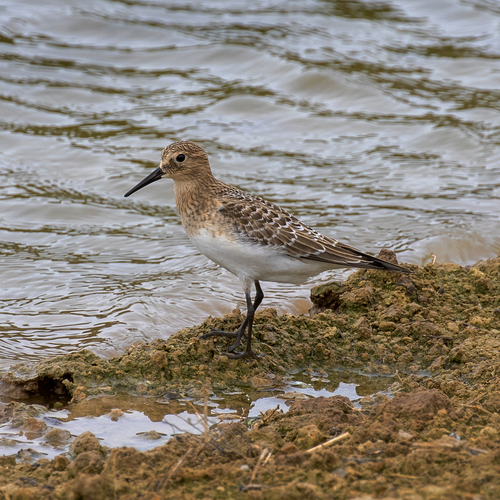
Sanderling vs Baird's Sandpiper
Calidris alba versus Calidris bairdii
Play a quiz with Sanderling and Baird's Sandpiper

Sanderling
Baird's Sandpiper
In short
Sanderlings and Baird's Sandpipers can be tricky to differentiate, especially in nonbreeding plumage. The most reliable field mark is their structure: Sanderlings have a shorter, stouter bill and appear more compact, while Baird's Sandpipers have a longer, thinner bill and a more elongated body with longer wings.
Identification tips
- Bill shape and size: Sanderlings have a shorter, thicker bill; Baird's Sandpipers have a longer, thinner bill.
- Body shape: Sanderlings appear more compact; Baird's Sandpipers are more elongated with longer wings.
- Plumage tone: Look for the paler, more uniform gray of Sanderlings versus the warmer brown and scalloped back of Baird's Sandpipers.
- Habitat preference: Sanderlings on sandy beaches; Baird's Sandpipers in inland mudflats or tundra.
Size
Sanderlings are slightly larger and more robust than Baird's Sandpipers, which are more slender and have longer wings relative to their body size.
Plumage
In nonbreeding plumage, Sanderlings are generally paler with a more uniform gray appearance, while Baird's Sandpipers have a warmer brown tone with a more scalloped look on the back. Sanderlings lack the distinct buffy wash on the breast that Baird's Sandpipers often show.
Behaviour
Both species forage actively on the ground, but Sanderlings are often seen running back and forth with the waves on sandy beaches, whereas Baird's Sandpipers are more likely to be found in inland mudflats or grassy tundra.
Habitat
Sanderlings are typically found on sandy beaches during migration and winter, while Baird's Sandpipers prefer inland habitats such as mudflats and grassy tundra during migration.
Voice
Vocalizations are not a primary distinguishing feature in the field, as both species have similar high-pitched calls.