
Sanderling vs Little Stint
Calidris alba versus Calidris minuta
Play a quiz with Sanderling and Little Stint
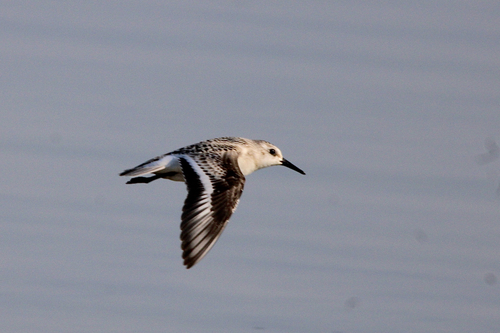 Sanderling
 Little Stint
In short
The most reliable field mark between Sanderling and Little Stint is the Sanderling’s strong white wingbar in flight, visible in all ages, contrasted with the Little Stint’s lack of such a prominent wingbar. Sanderling is also noticeably stouter, with a thicker bill and a distinctive running gait on open sandy beaches, while Little Stint is smaller, more delicate, with a fine-tipped bill, dark legs, and a longer primary projection. Juvenile Little Stints show pale crown stripes and a pinkish breast, which Sanderlings lack. In winter, both species can look similar, but structural differences and habitat preferences help: Sanderling prefers open sandy beaches, while Little Stint is more often on muddy or vegetated edges.
Identification tips
- White wingbar in flight (all ages): Sanderling always shows a strong white wingbar when flying, which Little Stint lacks. Use this as your first check for birds in flight.
- Size and structure: Sanderling is bulkier and stouter, with a thicker, blunter bill; Little Stint is smaller, finer-billed, and more delicate overall. Compare directly if both are present.
- Primary projection: Little Stint has a noticeably long primary projection (wing-tips extending beyond the tail), giving a long-winged look, especially at rest. Sanderling’s primaries are shorter relative to the tail.
- Bill shape: Sanderling’s bill is thick and straight, while Little Stint’s is fine, thin, and pointed. This is best seen at close range.
- Leg color: Both species have dark legs, so this is not helpful for separation.
- Juvenile plumage: Juvenile Little Stint shows pale crown stripes and a pinkish breast, sometimes with a white 'V' on the back. Sanderling juveniles lack these features and are plainer.
- Breeding plumage: Little Stint adults in breeding plumage have an orange wash to the breast and a white throat; Sanderling lacks these colors and is more uniform.
- Non-breeding (winter) plumage: Both species become pale, but Sanderling is often almost white, especially on the underparts, while Little Stint remains slightly greyer and smaller.
- Toe structure: Little Stint has unwebbed toes; Sanderling lacks a hind toe, but this is rarely visible in the field.
- Behavior: Sanderling runs rapidly along the wave line of sandy beaches with a unique 'bicycling' gait, often in flocks. Little Stint moves more delicately and is more likely to be seen picking at mud or pool edges.
- Habitat: Sanderling is almost always on open sandy beaches; Little Stint prefers mudflats, pool edges, and vegetated margins, though can overlap on migration.
- Voice: If you hear a sharp 'stit' call, it is Little Stint. Sanderling’s call is not described here.
- Feeding action: Sanderling feeds by running and stopping to pick prey, often chasing receding waves. Little Stint picks more methodically at the substrate.
- Flock composition: In mixed flocks, Sanderling stands out as the larger, paler, chunkier bird; Little Stint blends in with other small stints.
- Pitfalls: In poor light or at distance, the paleness of Sanderling can be confused with Little Stint, especially in winter. Always check structure, wingbar in flight, and behavior for confirmation.
Size
Little Stint is significantly smaller and lighter than Sanderling. The Little Stint’s average body mass is about 25.5g [wikidata], while Sanderling is bulkier and stouter (though precise mass is not given, it is similar in size to Dunlin, which is heavier than Little Stint). Sanderling’s overall structure is more robust, with a thicker bill and a chunkier appearance, while Little Stint is daintier, with a fine, pointed bill and a more delicate build.
Plumage
- Juvenile/immature plumage: Juvenile Little Stint shows pale crown stripes and a pinkish breast, plus a strong white 'V' on the back in fresh plumage. Sanderling juveniles lack these features and are generally plainer above.
- Wing pattern in flight (all ages): Sanderling shows a strong white wingbar, making it stand out in flight. Little Stint lacks this prominent wingbar.
- Adult breeding: Little Stint has an orange wash to the breast and a white throat; Sanderling in breeding plumage is more uniform and lacks the orange tones.
- Adult non-breeding (winter): Both species become pale, but Sanderling is even paler overall, often appearing almost white, while Little Stint remains slightly greyer and smaller, with a finer bill.
- Leg color: Little Stint always has dark legs; Sanderling’s legs are also dark, so this is not a reliable separator.
- Bill: Sanderling’s bill is thicker and blunter; Little Stint’s is fine and pointed.
Behaviour
Sanderlings are highly gregarious in winter, often forming large flocks that run rapidly along the wave line of sandy beaches with a characteristic 'bicycling' leg action, frequently stopping to pick food. Little Stints are also gregarious, but their movements are quicker and more delicate, and they are more likely to be seen picking at mud or the edges of pools rather than sprinting along open sand. Sanderling’s running behavior is distinctive and diagnostic when seen well.
Habitat
Sanderling is strongly associated with open sandy beaches and the upper intertidal zone, rarely venturing onto mudflats or vegetated edges except occasionally during migration. Little Stint is more flexible, often found on coastal mudflats, the edges of inland pools, and sometimes sandy areas, but is less tied to open beaches than Sanderling. If the bird is on a broad, wave-washed sandy beach, Sanderling is much more likely; on muddy or vegetated margins, Little Stint is the better candidate.
Voice
Little Stint gives a sharp 'stit' call, which is diagnostic if heard. Sanderling’s call is not described in the provided notes, so voice is only useful if the sharp 'stit' is heard, pointing to Little Stint.