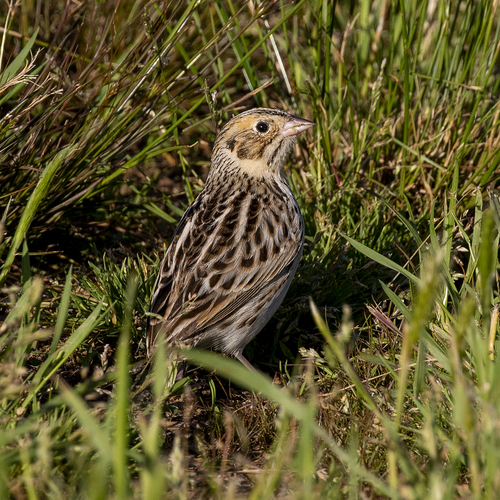
Savannah Sparrow vs Baird's Sparrow
Passerculus sandwichensis versus Centronyx bairdii
Play a quiz with Savannah Sparrow and Baird's Sparrow
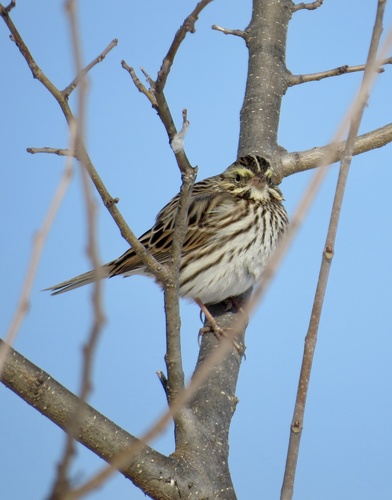
Savannah Sparrow
Baird's Sparrow
In short
Savannah Sparrow and Baird's Sparrow can be distinguished by their head patterns and habitat preferences. Savannah Sparrows have a distinct yellowish supercilium, while Baird's Sparrows have a more buffy, less contrasting facial pattern. Both species are similar in size, but their preferred habitats differ, with Savannah Sparrows favoring open fields and Baird's Sparrows preferring native grasslands.
Identification tips
- Look for the yellowish supercilium on Savannah Sparrows. 2. Note the habitat: Savannah Sparrows are more adaptable, while Baird's Sparrows are grassland specialists. 3. Listen for the song: buzzy in Savannah Sparrows, more musical in Baird's Sparrows. 4. Observe the breast pattern: more streaked in Savannah Sparrows, with a central spot in Baird's Sparrows.
Size
Both species are similar in size, typical of small sparrows.
Plumage
Savannah Sparrows have a yellowish supercilium and more streaking on the breast, while Baird's Sparrows exhibit a buffy facial pattern and less streaking, with a more defined central breast spot.
Behaviour
Both species can be secretive, but Savannah Sparrows are more likely to be seen in a variety of open habitats, while Baird's Sparrows are more tied to native grasslands.
Habitat
Savannah Sparrows are found in a wide range of open habitats, including fields and coastal grasslands, whereas Baird's Sparrows are more restricted to native grasslands.
Voice
Savannah Sparrows have a buzzy song, while Baird's Sparrows have a more musical, tinkling song. These differences can be subtle and require experience to distinguish.